
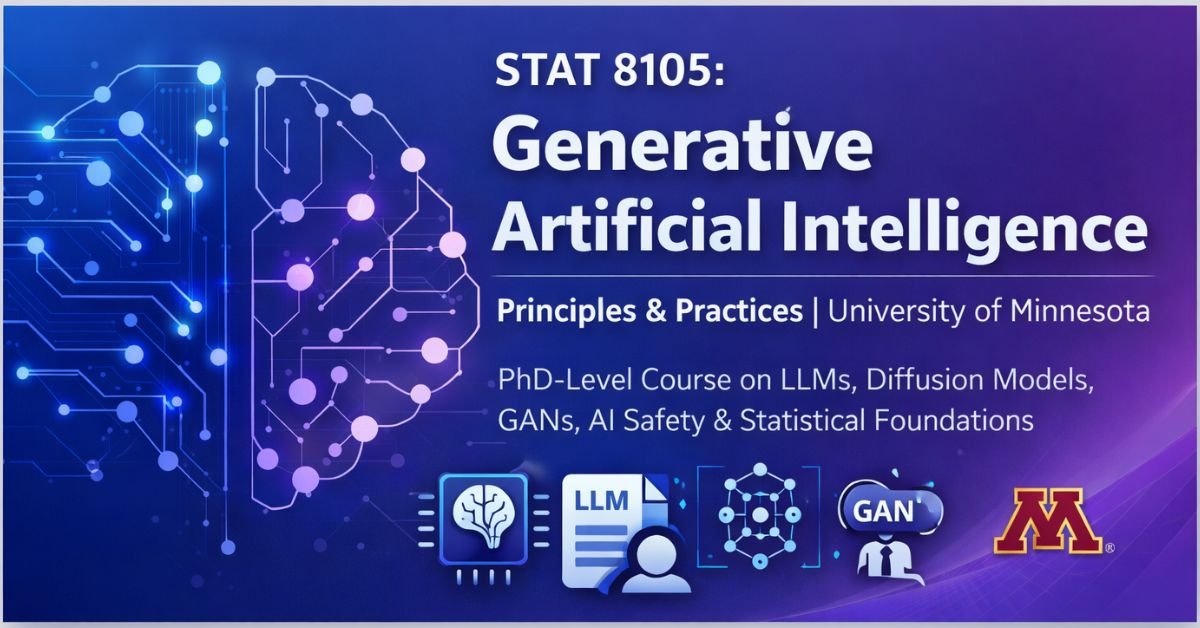
STAT 8105: Generative Artificial Intelligence
Principles and Practices | University of Minnesota
Course Overview & Philosophy
A Research-Oriented Approach to Generative AI
STAT 8105 represents a unique intersection between theoretical rigor and practical application in the rapidly evolving field of generative artificial intelligence. Designed specifically for PhD students and advanced researchers, this course goes beyond surface-level tool usage to provide a holistic understanding of the foundational principles that power modern generative AI systems. Students engage with state-of-the-art research while developing the critical thinking skills necessary to contribute meaningfully to this transformative field.
Unlike introductory courses that focus primarily on using pre-built models, STAT 8105 emphasizes the statistical and mathematical foundations underlying generative AI techniques. The curriculum bridges the gap between classical statistical theory and cutting-edge deep learning architectures, equipping PhD research students with both the conceptual frameworks and hands-on experience needed to push the boundaries of what’s possible with generative models.
Detailed Course Syllabus & Schedule
Core Curriculum Modules
The course spans 15 weeks, with each module building progressively on foundational concepts while introducing advanced techniques and algorithms. Students engage with both classical statistical methods and modern deep learning approaches, understanding how they complement each other in the context of generative modeling.
| Module | Topic | Key Concepts & Techniques | Duration |
|---|---|---|---|
| 1 | Foundations of Generative Modeling | Probability distributions, maximum likelihood estimation, statistical inference, generative vs discriminative models | 2 weeks |
| 2 | Deep Learning Fundamentals | Neural network architectures, backpropagation, optimization algorithms, regularization techniques | 2 weeks |
| 3 | Variational Autoencoders (VAEs) | Variational inference, ELBO optimization, latent space representations, conditional VAEs | 1.5 weeks |
| 4 | Generative Adversarial Networks (GANs) | Adversarial training, Nash equilibria, mode collapse, advanced GAN architectures (StyleGAN, BigGAN) | 1.5 weeks |
| 5 | Diffusion Models & Score Matching | Forward and reverse diffusion processes, denoising score matching, DDPM, DDIM, guidance techniques | 2 weeks |
| 6 | Large Language Models (LLMs) | Transformer architectures, attention mechanisms, pre-training and fine-tuning, scaling laws | 2 weeks |
| 7 | Advanced Topics in GenAI | Retrieval-augmented generation (RAG), multimodal models, efficient inference, model compression | 2 weeks |
| 8 | AI Safety, Ethics & Alignment | RLHF, constitutional AI, fairness metrics, toxicity detection, interpretability methods | 1.5 weeks |
| 9 | Final Project Period | Research proposal development, implementation, experimentation, and presentation | Ongoing |
Final Research Project
The capstone of STAT 8105 is an independent research project that allows students to apply the principles and techniques learned throughout the course to a problem of their choosing. Students develop a comprehensive project proposal, implement their approach using state-of-the-art frameworks, conduct rigorous experiments, and present their findings to the class. This hands-on experience mirrors the research process in academic and industry settings, preparing students for careers at the frontier of AI research.
Past projects have explored diverse applications including AI-for-science applications in drug discovery, autonomous systems for robotics, digital health diagnostics, creative content generation, and novel architectures for efficient training. Students receive personalized mentorship and have access to significant computational resources through the Minnesota Supercomputing Institute.
Prerequisites & Student Expectations
Technical Background Required
Success in STAT 8105 requires a solid foundation in several technical areas. Students should have substantial experience with Python programming, including familiarity with scientific computing libraries such as NumPy, SciPy, and Matplotlib. Prior coursework or practical experience in machine learning is essential, ideally including topics like supervised learning, optimization, and model evaluation.
A strong background in statistics and probability theory is critical for understanding the theoretical underpinnings of generative models. Students should be comfortable with concepts including probability distributions, statistical inference, hypothesis testing, and multivariate calculus. Linear algebra fundamentals, particularly matrix operations, eigendecomposition, and vector spaces, appear throughout the course material.
- STAT 5052 (Introduction to Machine Learning) or equivalent experience
- STAT 5303 (Statistical Computing) or demonstrated Python proficiency
- Graduate-level probability and statistical theory
- Experience with deep learning frameworks (PyTorch preferred) is helpful but not required
Learning Commitment & Mindset
Beyond technical prerequisites, STAT 8105 demands significant self-motivation and intellectual curiosity. The field of generative AI evolves rapidly, and students must be prepared to engage with cutting-edge research papers, some published just weeks before the semester begins. Critical thinking skills are essential for evaluating claims, understanding limitations, and identifying promising research directions.
Students should expect to dedicate approximately 12-15 hours per week to the course, including lectures, readings, programming assignments, and project work. The course rewards those who actively participate in discussions, ask probing questions, and collaborate with peers on challenging problems. A growth mindset and willingness to tackle difficult concepts through persistence and experimentation will serve students well.
Technical Setup & University Resources
Software Environment: Python and PyTorch
All programming assignments and projects in STAT 8105 use Python as the primary language, with PyTorch serving as the deep learning framework. Students work within carefully configured virtual environments that include all necessary dependencies for reproducible research. The course provides detailed setup instructions and troubleshooting guides to ensure everyone can focus on learning rather than configuration issues.
Weekly coding assignments are distributed as Jupyter notebooks, allowing for interactive development and immediate visualization of results. Students learn best practices for experiment tracking, version control with Git, and documentation that facilitates collaboration and reproducibility. The curriculum emphasizes writing clean, efficient code that can scale from prototypes to production systems.
Hardware: GPU Access via Minnesota Supercomputing Institute (MSI)
Training modern generative models requires substantial computational resources that go far beyond typical laptop capabilities. All enrolled students receive access to the Minnesota Supercomputing Institute, one of the premier academic computing facilities in the United States. MSI provides high-performance GPU clusters specifically designed for machine learning workloads, enabling students to train models that would otherwise be impossible in an academic setting.
The course includes dedicated tutorials on using MSI’s job scheduling systems, optimizing GPU utilization, and monitoring training runs. Students learn to write efficient data loading pipelines, implement distributed training when appropriate, and manage computational budgets effectively. This practical experience with professional-grade infrastructure prepares students for research positions in both academia and industry where access to such resources is standard.
The Statistical Foundation of Modern AI
One of the distinguishing features of STAT 8105 is its emphasis on the deep connections between classical statistical theory and contemporary artificial intelligence. While many AI courses treat machine learning as purely an engineering discipline, this course recognizes that the most powerful generative models are fundamentally statistical in nature. Understanding these connections provides students with principled approaches to model design, training, and evaluation that go beyond trial-and-error experimentation.
The University of Minnesota’s School of Statistics has long been at the forefront of developing statistical methods that now underpin modern AI systems. From foundational work in Bayesian inference to recent contributions in uncertainty quantification and causal reasoning, Minnesota’s tradition of rigorous statistical reasoning directly informs the course philosophy. Students benefit from this heritage through guest lectures from faculty whose research bridges statistics and machine learning.
The course explores how generative models can be understood through the lens of statistical estimation theory, examining questions about model identifiability, consistency, and efficiency that classical statisticians have studied for decades. Topics like variational inference connect directly to statistical approximation methods, while diffusion models relate to time series analysis and stochastic processes. This perspective empowers students to not just use existing models but to develop new approaches grounded in solid theoretical foundations.
The Data Science and AI Hub (DSAI) at the University of Minnesota provides additional context and resources for students interested in how statistical thinking applies to real-world AI challenges. Through DSAI-sponsored seminars, workshops, and collaboration opportunities, students in STAT 8105 can engage with industry partners and interdisciplinary research teams working on applications ranging from healthcare to climate science to social good initiatives.
Ethics, Safety, and Societal Impact
Aligning AI with Human Values
As generative AI systems become increasingly powerful and widely deployed, ensuring they behave in accordance with human values becomes paramount. STAT 8105 dedicates substantial time to exploring techniques for AI alignment, including reinforcement learning from human feedback (RLHF), which has proven effective in making language models more helpful, harmless, and honest. Students implement RLHF pipelines, learning to collect preference data, train reward models, and fine-tune generative models using policy gradient methods.
The course examines fairness in generative models, investigating how biases in training data can lead to outputs that perpetuate harmful stereotypes or exclude marginalized groups. Students learn to measure and mitigate various forms of bias, implement fairness constraints during training, and evaluate models across diverse demographic groups. Toxicity detection and content filtering receive particular attention given the widespread use of generative models in public-facing applications.
Security and Robustness
Generative AI systems face unique security challenges that don’t affect traditional software. The course covers adversarial examples and their implications for model robustness, teaching students to both craft attacks and defend against them. Data poisoning attacks, where malicious actors corrupt training data to compromise model behavior, receive detailed treatment with hands-on exercises in detecting and preventing such attacks.
As generative models become capable of producing increasingly realistic synthetic content, watermarking and provenance tracking become critical tools for maintaining information integrity. Students explore state-of-the-art watermarking techniques for images, audio, and text, learning the trade-offs between imperceptibility, robustness, and capacity. The course also examines detection methods for identifying AI-generated content and the arms race between generation and detection that continues to evolve.
Throughout these discussions, students engage with real-world case studies of AI systems that have had unintended negative consequences, analyzing what went wrong and how better practices could have prevented harm. The goal is to cultivate a sense of responsibility and ethical awareness that students carry forward into their research and professional careers.
Career Pathways and Further Learning
Research and Industry Opportunities
Completing STAT 8105 opens doors to exciting career opportunities at the intersection of statistics, computer science, and artificial intelligence. Many students pursue academic research careers, with course alumni now working as postdoctoral researchers and faculty members at leading universities worldwide. The rigorous training in both theory and implementation prepares students to publish in top-tier conferences and journals in machine learning, statistics, and domain-specific venues.
Industry demand for expertise in generative AI has exploded in recent years, with major technology companies, startups, and research labs actively recruiting PhD-level talent. Students from STAT 8105 have joined organizations working on AI-for-science applications in pharmaceutical development and materials discovery, autonomous systems for self-driving vehicles and robotics, digital health tools for diagnosis and treatment planning, creative AI for entertainment and design, and fundamental research on next-generation model architectures.
The course’s emphasis on both theoretical understanding and practical implementation makes graduates valuable in roles ranging from research scientist positions focused on developing new algorithms to applied machine learning engineer roles deploying systems at scale. The experience with large-scale computational infrastructure through MSI directly transfers to industry settings where managing training runs on GPU clusters is routine.
Related UMN Courses and Programs
Students interested in deepening their expertise can explore several related offerings at the University of Minnesota. STAT 5052 (Introduction to Machine Learning) provides foundational knowledge for those who need to strengthen their background before taking STAT 8105. STAT 5303 (Statistical Computing) develops the programming and computational skills essential for modern data science work. Advanced students might also consider courses in experimental design, Bayesian statistics, and optimization theory that complement the generative modeling focus.
Beyond the Statistics Department, relevant courses appear in Computer Science (deep learning, natural language processing, computer vision), Mathematics (optimization, differential equations), and domain-specific departments where AI applications are transforming research. The interdisciplinary nature of AI research at Minnesota encourages students to build connections across departments and participate in collaborative projects that address complex real-world challenges.
View Related Courses Explore DSAI HubFrequently Asked Questions (FAQs)
Enrollment and Logistics
STAT 8105 is primarily designed for University of Minnesota PhD students in Statistics and related fields. However, advanced graduate students from other departments at UMN may enroll with instructor permission, particularly if they can demonstrate the necessary prerequisites and have a clear research interest in generative AI. Students from other universities should contact the instructor to discuss potential visiting student arrangements or auditing options.
The course is offered annually during the spring semester. Specific scheduling information and enrollment dates are available through the University’s course registration system. Students planning to take the course should ensure they complete prerequisite coursework by the fall semester to be adequately prepared.
Enrollment is intentionally kept small, typically between 15-25 students, to facilitate meaningful discussion, personalized feedback on projects, and adequate computational resources for everyone. This intimate setting encourages collaboration and allows the instructor to tailor content to student interests and backgrounds.
Course Content and Preparation
Students should be comfortable writing non-trivial Python programs independently, including experience with object-oriented programming, debugging, and using scientific libraries like NumPy and pandas. While prior experience with PyTorch or TensorFlow is helpful, dedicated tutorials early in the semester help students who are new to deep learning frameworks get up to speed. The key is willingness to invest time in learning new tools rather than starting with complete mastery.
STAT 8105 deliberately balances theory and practice. Unlike purely theoretical courses that focus only on mathematical proofs, or purely applied courses that treat models as black boxes, this course develops deep theoretical understanding while requiring substantial hands-on implementation. Students both derive mathematical properties of generative models and code them from scratch, gaining intuition that comes only from working at both levels simultaneously.
While many machine learning courses cover generative models briefly as one topic among many, STAT 8105 focuses exclusively on generative modeling with depth impossible in broader surveys. The statistical perspective distinguishes it from computer science courses that may emphasize engineering and systems aspects. The PhD-level rigor means engaging with research papers, proving theoretical results, and conducting original research rather than just applying existing tools to standard datasets.
Yes, with appropriate background and instructor permission. PhD students from Computer Science, Mathematics, Electrical Engineering, and domain sciences like Physics or Biology have successfully completed the course. The critical factors are meeting the technical prerequisites in programming, mathematics, and statistics, plus having research interests that align with generative AI. Master’s students are generally not admitted given the PhD-level expectations, though exceptional cases may be considered.
Projects and Outcomes
Final projects should demonstrate research-level thinking and execution. This typically means identifying an open problem in generative AI, proposing a novel solution or analysis, implementing the approach carefully, conducting thorough experiments, and presenting results with appropriate statistical rigor. Projects that extend existing methods to new domains, develop theoretical understanding of model behavior, or improve efficiency and scalability are all appropriate. The instructor provides guidance on scoping projects to be ambitious yet achievable within the semester timeline.
Strong projects have the potential to become conference papers or journal articles with additional development. The instructor mentors interested students on expanding course projects into publishable research, and several past projects have resulted in publications at machine learning conferences. However, the primary goal is learning and skill development rather than publication, so projects are evaluated on their educational value and execution rather than novelty alone.
Ethics and safety considerations are integrated throughout the entire curriculum rather than treated as an afterthought. When studying language models, students examine bias and toxicity. When covering image generation, issues of deepfakes and misinformation receive attention. The dedicated module on AI alignment explores these topics systematically, but the course maintains the perspective that responsible AI development requires thinking about societal impact at every stage of the research and development process.
All students receive accounts on the Minnesota Supercomputing Institute with generous allocations of GPU time on modern hardware including NVIDIA A100 GPUs. MSI staff provide technical support and training on using the cluster effectively. For most course projects, the computational resources available through MSI exceed what students would have access to even at well-funded industry research labs. Students also learn to optimize their code to make efficient use of these resources, a valuable skill for future research.
Get Started with STAT 8105
If you’re a PhD student passionate about understanding and advancing the field of generative artificial intelligence from a rigorous statistical perspective, STAT 8105 offers an unparalleled opportunity to develop expertise that will define your research career. The combination of theoretical depth, hands-on implementation experience, access to world-class computational resources, and mentorship from faculty at the forefront of AI research creates an environment where ambitious students can thrive.
For more information about enrollment, prerequisites, or the current semester’s specific topics and schedule, please contact the instructor or visit the School of Statistics office. Prospective students are encouraged to review the technical prerequisites carefully and reach out with questions about whether the course is the right fit for their background and goals.
Contact Instructor View Prerequisites School of Statistics
При выборе системы важно учитывать не только производительность, но и возможности модернизации. Компьютер игровой цена зависит от уровня комплектующих и выбранной платформы.
Если хочется начать играть сразу после покупки, стоит обратить внимание на уже протестированные конфигурации с гарантией. Поэтому готовый компьютер для игр станет удобным решением без необходимости самостоятельной сборки.
Современный пк для игр обеспечивает плавный игровой процесс благодаря производительным комплектующим. Он также отлично подходит для стриминга и монтажа видео.
Discover more about oral care at pro dentim official website and see what makes it stand out.
The platform offers practical details that may help people better understand routine care.
## Section 2
If the content is easy to read, people can focus on the details that matter most.
## Section 3
A site that reduces confusion can leave a stronger impression on careful readers.
## Section 4
That combination can make the site easy to remember for visitors who appreciate simplicity.
Узнайте на драйвер и блок питания разница, чем отличается блок питания от LED-драйвера и как правильно выбрать источник питания для светодиодной ленты.
С помощью публикаций можно заранее рассчитать основные параметры и предотвратить распространённые недочёты.
### Раздел 2. Выбор оборудования
К рассчитанному потреблению рекомендуется добавить запас около двадцати процентов.
### Раздел 3. Подключение и безопасность
Монтаж оборудования следует выполнять при отключённом электропитании.
### Раздел 4. Практическая польза сайта
Благодаря ясным советам можно выбрать комплект под определённую цель и имеющиеся финансовые возможности.
Veery shoortly this wbsite will be famous amongg all blokg people, ddue tto it’s nice content
xnxx