
Washington, United States
Science Desk | International News
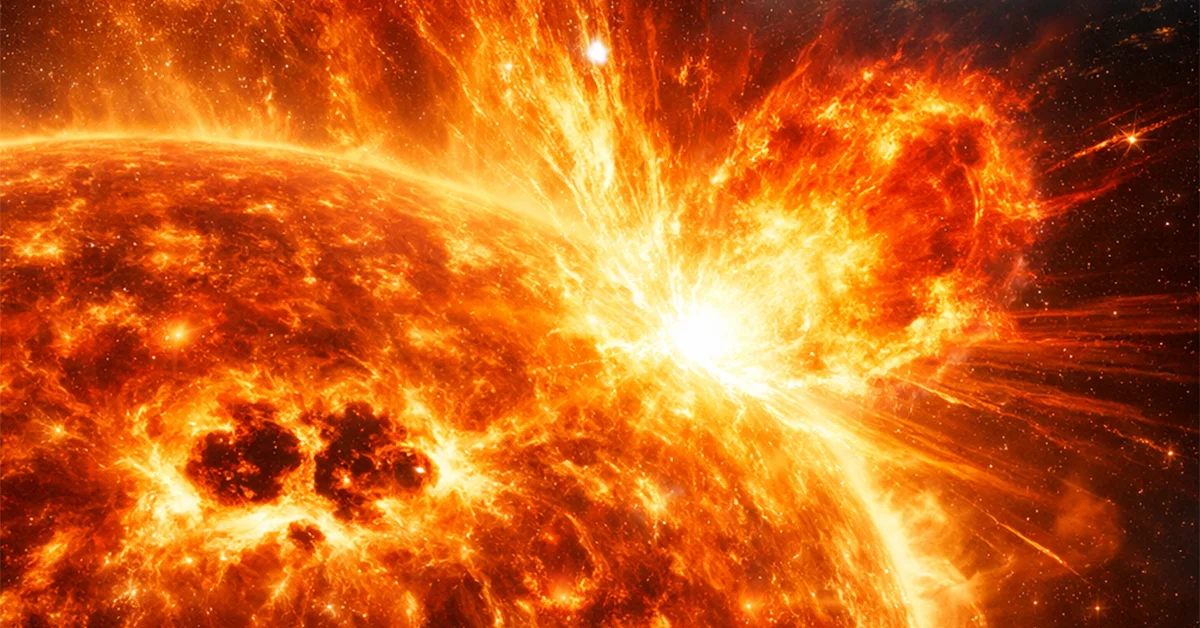
A series of powerful solar flares, including multiple X-class eruptions, have been recorded from an unusually active region of the Sun this week, space weather authorities and solar observatories reported Monday. The strongest flare, classified as an X8.1 event, erupted late on February 1, marking one of the most intense solar outbursts in recent months and prompting space weather alerts from forecasting agencies.
The Solar Flares stem from sunspot region AR4366, which has rapidly developed into a large, magnetically complex active area capable of producing extreme eruptions, scientists said. Sunspots are cooler, highly magnetic regions on the Sun’s surface that can unleash bursts of energy and charged particles.
The National Oceanic and Atmospheric Administration’s Space Weather Prediction Center logged the X8.1 flare at 23:44 UTC on February 1, followed by a subsequent X2.9-class flare about an hour later. These explosions generated strong radio blackouts across Earth’s sunlit hemisphere, disrupting some high-frequency (HF) communications over portions of the Pacific.
Earlier activity from AR4366 has included several additional X-class and numerous M-class flares over the past 24 hours, underscoring the region’s instability. Observations from ground- and space-based solar telescopes have shown the magnetic configuration of the sunspot is particularly complex, a key factor in driving solar flare production.
Solar flares are intense bursts of electromagnetic radiation released when magnetic energy built up in the solar atmosphere is suddenly unleashed. The strongest, known as X-class flares, can affect Earth’s ionosphere, causing temporary radio blackouts and, when associated with coronal mass ejections (CMEs), geomagnetic disturbances that enhance auroras and can impact satellite systems.
Forecasters are continuing to monitor Solar Flares activity for further eruptions and potential CME impacts. While direct harm to people on the ground is unlikely due to Earth’s protective magnetic field and atmosphere, technological systems — particularly radio communications and navigation networks — can be sensitive to severe space weather.
Space agencies and research institutions will remain vigilant as the Sun continues its current cycle of heightened activity, which is expected to sustain elevated flare rates in the coming days. The story is developing.
ALSO READ: Personal Injury Lawyers Face Growing Scrutiny Over Advertising Practices

matter to in CBD health just don’t live where to starting signal? understand our comp thc gummies online order run to learn how virginal CBD, to the full spectrum CBD, and CBD keep apart support your consistency. different THC, double-dyed CBD provide non-psychoactive gain that keep back you sharp and unwind. Whether you opt CBD vegetable oil strike down, CBD edible, or CBD capsules, we explain CBD dose so you bottom weft the practiced CBD intersection. Start your raw CBD travel nowadays with complete self-assurance in qualified organic fertilizer CBD!