

Table of Contents
- Introduction
- Understanding Zero Trust Networking
- The Need for Zero Trust in Remote Work
- Key Components of Zero Trust Networking
- Implementing Zero Trust in Your Organization
- Challenges and Considerations
- Conclusion
The rapid shift to remote work has revolutionized organizational structures and workplace norms. While employees and businesses both benefit from this newfound flexibility, remote connectivity also presents major security concerns. Legacy perimeter-based security models are being pushed to their limits, as employees frequently log in from diverse networks and personal devices. Organizations are therefore seeking improved security frameworks, such as Secure Access Service Edge solutions, to address vulnerabilities in remote work environments.
Zero Trust Networking (ZTN) stands out as a transformative approach in this context. By requiring strict verification for every access request, regardless of the user’s or device’s location, ZTN shifts the mindset from “trust but verify” to “never trust, always verify.” This comprehensive approach helps protect sensitive data and resources against evolving cyber threats.
As cyberattackers adopt more sophisticated tactics, companies with distributed teams risk increased data breaches or unauthorized access incidents. Zero Trust mitigates these risks by continuously authenticating users and devices, limiting exposure to potential threats. Such proactive measures not only defend against external attacks but also mitigate risks arising from compromised internal credentials.
The principles of Zero Trust are rapidly gaining traction among security leaders, who must balance employee productivity with security controls. Organizations that wish to maintain operational integrity while scaling their remote workforce must adopt frameworks that are both agile and robust. Integrating Zero Trust strategies enables granular security decisions, strengthening protection at every access point.
Understanding Zero Trust Networking
Zero Trust Networking is fundamentally different from traditional perimeter-focused security methods. Instead of assuming all users or devices within a network can be trusted, ZTN treats every connection as suspicious until proven safe. It relies on a set of security protocols in which each access attempt is rigorously authenticated, authorized, and continuously validated.
The model operates under the philosophy that threats can originate from both inside and outside the network. By demanding continuous proof of user identity and device integrity, ZTN shrinks the opportunity for malicious actors to move laterally within an environment. This not only mitigates the impact of potential breaches but also helps organizations align with compliance requirements such as those defined in GDPR or HIPAA frameworks.
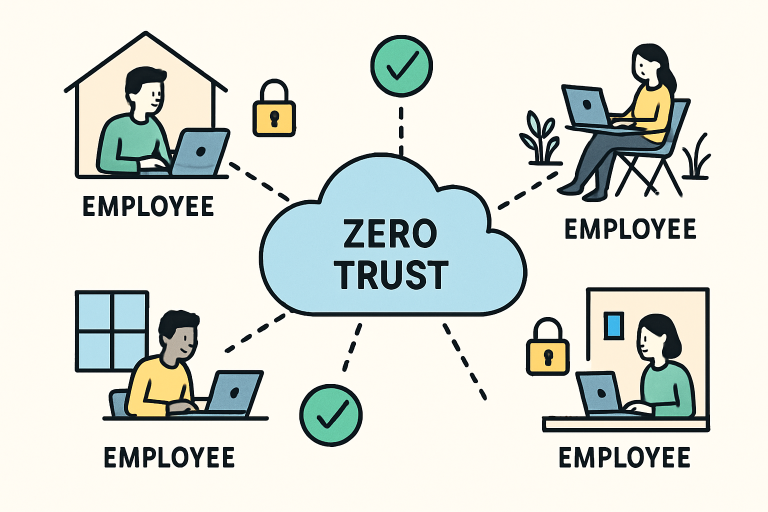
The Need for Zero Trust in Remote Work
With millions of employees embracing remote and hybrid arrangements, the boundaries of enterprise networks have dissolved. The attack surface now spans homes, coffee shops, and mobile hotspots, rather than being confined to secured office networks. According to Gallup, 50 percent of remote-capable employees work in hybrid environments, highlighting the growing demand for flexible yet secure solutions.
This new reality exposes organizations to a higher risk of phishing, malware, and ransomware that exploit endpoint vulnerabilities. If even one remote employee’s credentials are breached, an attacker could potentially access sensitive company resources. Implementing Zero Trust reduces these risks by verifying user identities and device postures before granting access, whether the request originates from inside or outside the corporate network.
Key Components of Zero Trust Networking
- Identity Verification: User identities are continuously verified using criteria such as multi-factor authentication, strong passwords, and behavioral analytics. This ensures that only authorized personnel have access to sensitive resources.
- Device Security: Every device attempting to join the network is assessed for compliance. Unmanaged or non-compliant devices can be denied or limited in their access, helping contain potential breaches.
- Least Privilege Access: Users are granted only the permissions and data access necessary for their roles. By strictly limiting access, organizations minimize the risk created by compromised accounts or insider threats.
- Continuous Monitoring: Real-time monitoring detects suspicious activities and enforces access protocols. Automated systems can contain threats at the first sign of an anomaly, reducing incident impact.
Implementing Zero Trust in Your Organization
- Assess Current Security Posture: Begin by evaluating existing security measures, identifying assets, and identifying gaps in legacy infrastructure relative to Zero Trust standards.
- Define Access Policies: Establish explicit policies that specify which users can access which resources and under what circumstances. This may require segmentation of the network and redefining user roles.
- Deploy Identity and Access Management (IAM) Solutions: Implement advanced IAM systems, including those that offer adaptive authentication and centralized access management. These tools streamline access controls and ensure policy compliance even as staff roles or devices change.
- Monitor and Respond: Adopt security solutions with automated monitoring, analytics, and incident response capabilities. Quick detection, investigation, and remediation of threats are vital to maintaining resilience.
Challenges and Considerations
The transition to Zero Trust is not without challenges. Integrating ZTN with legacy systems can be resource-intensive, especially for organizations with complex infrastructures. Employees may experience friction when controls are poorly implemented, and security teams accustomed to traditional architectures may face a steeper learning curve.
Furthermore, compliance with industry-specific regulations must be carefully considered while redesigning network security. Investing in employee education and choosing phased implementations can help overcome initial resistance and minimize disruption. Organizations can also benefit from third-party expertise and dedicated platforms, which accelerate deployment and simplify management. For more on overcoming Zero Trust adoption hurdles, see the practical guide from CSO Online.
Conclusion
Zero Trust Networking is a powerful, modern approach to securing the evolving landscape of remote and hybrid workforces. By assuming no connection is inherently trustworthy and rigorously testing every access request, organizations safeguard sensitive data and critical assets from both external and internal threats. As distributed work becomes the new standard, deploying ZTN helps ensure continuous protection and operational continuity, empowering employees to work flexibly and securely.

MOBI ROLLER is a tech enthusiast with a background in technology. He writes about the latest trends, tools, and innovations in the tech world, sharing insights based on both knowledge and experience.