
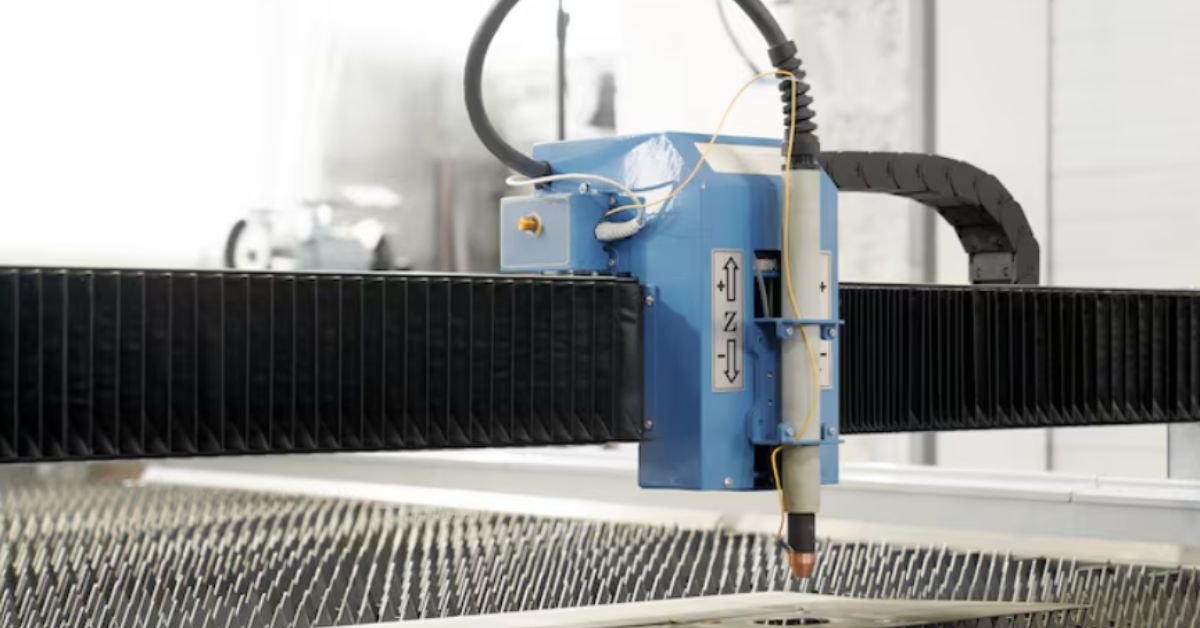
In the world of metal fabrication, there is a common misconception that “faster is always better.” When it comes to laser tube cutting, however, speed is a relative term. Unlike flat-sheet processing, success in tube fabrication is measured by the elimination of secondary operations and the reduction of total cycle time.
The core reality of laser tube cutting is that the machine is more than a cutter; it is a complete machining center. This guide explores the technical nuances of fiber vs. CO2 technology, the “power paradox” of tube cutting, and how to maximize ROI.
What is Laser Tube Cutting?
Laser tube cutting is a CNC-controlled process that uses a high power laser beam to cut complex shapes, holes, and end-profiles into hollow metal sections. This includes round, square, and rectangular tubes, as well as open profiles like C-channels and angle iron.
The primary benefit of this technology is consolidation. Traditionally, a tube might move from a saw to a drill press, then to a milling machine, and finally to a deburring station. A laser tube machine performs all these tasks in a single setup, delivering a part that is ready for welding or assembly immediately upon unloading.
Fiber vs. CO2: Which Technology Wins?
While CO2 was once the industry standard, fiber laser technology has largely taken the lead due to its efficiency and lower operating costs.
Technical Differences in Laser Generation
The laser “generator” in a fiber system is created by banks of diodes arranged in briefcase-sized modules. These modules are spliced together to create the final resonator, typically the size of a small filing cabinet.
In contrast, a CO2 resonator is significantly larger, requiring a complex mix of gases and high electricity consumption to generate a beam.
Handling Reflective Materials
Fiber lasers utilize a 1.06-micron wavelength, which is 10% smaller than CO2. This smaller wavelength is much more easily absorbed by reflective metals like brass, copper, and aluminum.
CO2 beams are often reflected off these surfaces, which can not only fail to cut the part but also damage the expensive mirrors and beam paths within the machine.
Operating Costs and Maintenance
Fiber lasers are delivered via fiber-optic cable, meaning there are no mirrors to clean or align. As long as the chiller water is clean and air filters are replaced, the system is essentially free of preventive maintenance. This results in significantly higher uptime compared to CO2 systems.
Efficiency Over Raw Speed: The Power Paradox
In sheet metal cutting, manufacturers are currently racing toward 20kW and 30kW power levels. However, in laser tube cutting, more power is not always better.
The 5kW Power Limit
Most tube laser machines top out at 5kW. Why?
Because a tube is a hollow profile. If you apply 12kW of power to the top wall of a 1-inch square tube, the laser will “blow through” and damage the interior of the opposite wall before the CNC can compensate.
Total Process Time vs. IPM
In tube fabrication, the “Golden Nugget” of efficiency is Total Process Time. This includes:
- Loading: How fast can the machine pick up the next raw tube?
- Indexing: The time taken to move the tube to the zero point.
- Sensing: Detecting the tube’s orientation and imperfections.
- Cutting: The actual laser-on time.
- Unloading: Sorting the finished part into a bin.
If a machine cuts at 500 IPM but takes 30 seconds to load a new tube, it may be less efficient than a slower cutter with a faster loading cycle.
Overcoming Material Challenges
No tube is perfectly straight. Mill-standard tubing often arrives with “bows” (curvatures) and “twists.”
Weld Seam Detection
Most tubes are roll-formed and welded. This weld seam is harder than the base metal and can interfere with the aesthetics of a part or the placement of a hole.
Modern systems use optical sensors or internal cameras to detect the weld seam, allowing the software to rotate the tube so the seam is hidden or positioned away from critical cuts.
Active Compensation
To handle “bowed” tubes, traditional machines used mechanical touch-probing, which could add 5–10 seconds per part.
High-end laser tube cutting systems now use camera-based sensing to scan the tube in milliseconds, adjusting the cutting head’s path in real-time to ensure holes are perfectly centered even on a crooked workpiece.
Automated Material Handling
The “unseen” hero of a tube laser is the material handling system.
- Bundle Loaders: Ideal for high-volume runs of closed profiles. These systems singularize one tube at a time from a 5,000-lb bundle.
- Step Loaders: Required for open profiles (C-channels/Angles). Because these shapes “nest” into each other, they cannot be singularized from a bundle and must be laid out on steps.
- Unloading Logic: High-efficiency machines use conveyors to sort parts by length or job, ensuring that soft materials like aluminum are not scratched during the drop.
ROI: Is a Tube Laser Right for You?
The ROI for laser tube cutting is rarely found in the “cost per cut.” It is found in the elimination of downstream labor.
- Tab-and-Slot Design: You can design tubes that snap together like LEGO pieces. This eliminates the need for expensive welding fixtures and reduces assembly time by up to 50%.
- Accuracy: Because the laser is a single-point tool, tolerances are much tighter than manual drilling, leading to faster, more consistent welding.
- Wall Plug Efficiency: A fiber laser’s 40% efficiency means lower electricity bills and a smaller chiller, further reducing the cost per part.
Conclusion: The Future of Tube Fabrication
As the industry moves toward “Industry 4.0,” the focus is shifting toward software and integration. The best laser tube cutting machine isn’t the one with the most power; it’s the one that minimizes idle time and produces a finished part that requires zero secondary work.
Ready to optimize your shop? Start by auditing your current “floor-to-floor” time for your most common tube parts.
CLICK HERE FOR MORE BLOG POSTS
