
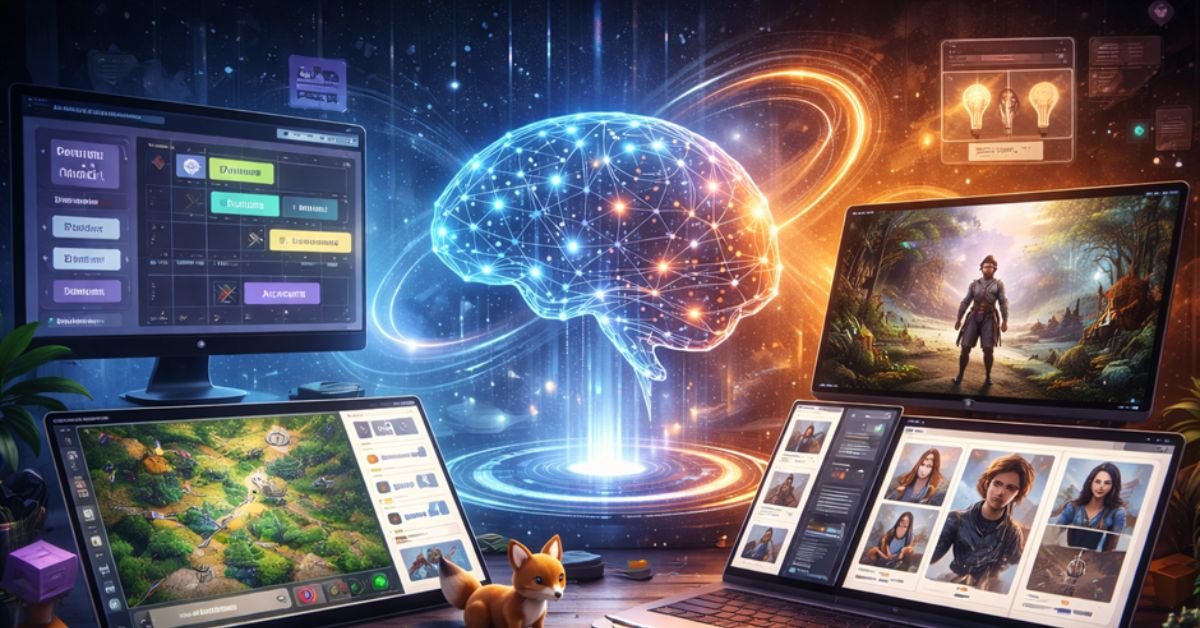
We are witnessing a technological convergence that is reshaping the digital landscape. For years, “no code” platforms promised to democratize software creation, while Artificial Intelligence (AI) promised to automate intelligence. Today, these two powerful forces have collided. The result is a paradigm shift in how we create, particularly in the complex world of video games.
The intersection of AI and no code game development is not just an incremental improvement; it is a multiplier effect. It takes the accessibility of drag-and-drop interfaces and supercharges them with the generative power of machine learning. This synergy is allowing creators to build games faster, smarter, and with a level of polish that was previously reserved for large studios.
In this article, we will explore how this powerful combination works, why it is the future of the industry, and how innovative titles like Trend Garden and Casma: El Despertar are proving that the best way to code might be not to code at all.
The Convergence: Where Logic Meets Intuition
To understand why this intersection is so revolutionary, we need to look at what each technology brings to the table.
No Code provides the structure. It offers the visual framework, the logic blocks, and the user interface that allow a human to organize a game without writing syntax. It makes the structure of development accessible.
AI provides the content and the intuition. It generates the assets, suggests the logic, and debugs the systems. It makes the substance of development accessible.
When you combine them, you eliminate the two biggest hurdles in game development: technical knowledge and asset production. You no longer need to know C# to make a character move, and you no longer need to be a pixel artist to make that character look good.
Accelerating the Development Cycle
The most immediate impact of combining AI and no-code game development is speed. Traditional game development is a marathon of distinct phases: prototyping, coding, asset creation, testing, and debugging. This process often takes years.
In this new model, these phases happen simultaneously.
- Rapid Prototyping: Instead of spending weeks coding a prototype, a creator can use AI prompts to generate a basic game loop within a no-code engine in minutes.
- Instant Assets: Instead of waiting for an art team to deliver sprites, the developer can use generative AI to populate the no-code environment instantly.
- Real-Time Logic Generation: If a mechanic isn’t working, the AI can analyze the visual script and suggest a fix immediately.
This allows for a “fail fast, succeed faster” workflow. Creators can iterate on their ideas in real-time, keeping the creative momentum alive.
Smarter Development: Expanding Creative Horizons
The intersection of these technologies doesn’t just make development faster; it makes it smarter. It allows solo developers and small teams to tackle projects that are conceptually ambitious.
In the past, scope was dictated by resources. A solo dev couldn’t make a massive RPG because they couldn’t write enough dialogue or draw enough maps. AI removes these constraints. An AI assistant can generate thousands of lines of dialogue or procedurally generate vast maps based on no-code rules sets.
The Democratisation of Professional Quality
Perhaps the most significant outcome of this intersection is that “accessible” no longer means “amateur.”
Historically, games made with simple game-maker tools were often looked down upon as toys. They lacked performance, depth, and polish. However, AI optimization is changing that narrative. Modern AI tools working within no-code platforms can optimize code in the background, ensuring games run smoothly on various devices. They can upscale assets to high definition and ensure consistent art styles.
This means that a game built by a teenager in their bedroom can technologically rival a game built by a team of professionals. The barrier to entry has lowered, but the ceiling for quality has risen significantly. You can try out this game, named Firework Frenzy, and can have idea of what I’m talking about.
The Future of the Hybrid Workflow
We are currently in the early stages of this revolution. As we look forward, the line between the AI and the no-code platform will blur until they are indistinguishable.
We will likely see:
- Self-development Games: No-code games that use AI to detect bugs while the player is playing and fix them in real-time.
- Personalized Experiences: Games that rewrite their own difficulty or narrative based on the specific player’s behavior, powered by live AI analysis.
- Voice-to-Game: The ability to build entire levels simply by speaking to the no-code platform, describing the world you want to see.
Conclusion
The intersection of AI and no-code game development is the most exciting frontier in digital creativity. It represents a move away from technical gatekeeping toward a future of pure expression. It empowers creators to build faster, iterate smarter, and dream bigger.
Whether it is the relaxing simulation of Trend Garden or the immersive world of Casma: El Despertar, the games emerging from this synergy are proof that the future of gaming is bright, accessible, and limitless. The tools are here. The only thing missing is your idea.

This is the kind of content people rave about — amazing!
Your energy is magnetic — this was amazing!
Your content always brings fresh insight.