
San Jose, United States
News Desk | Technology
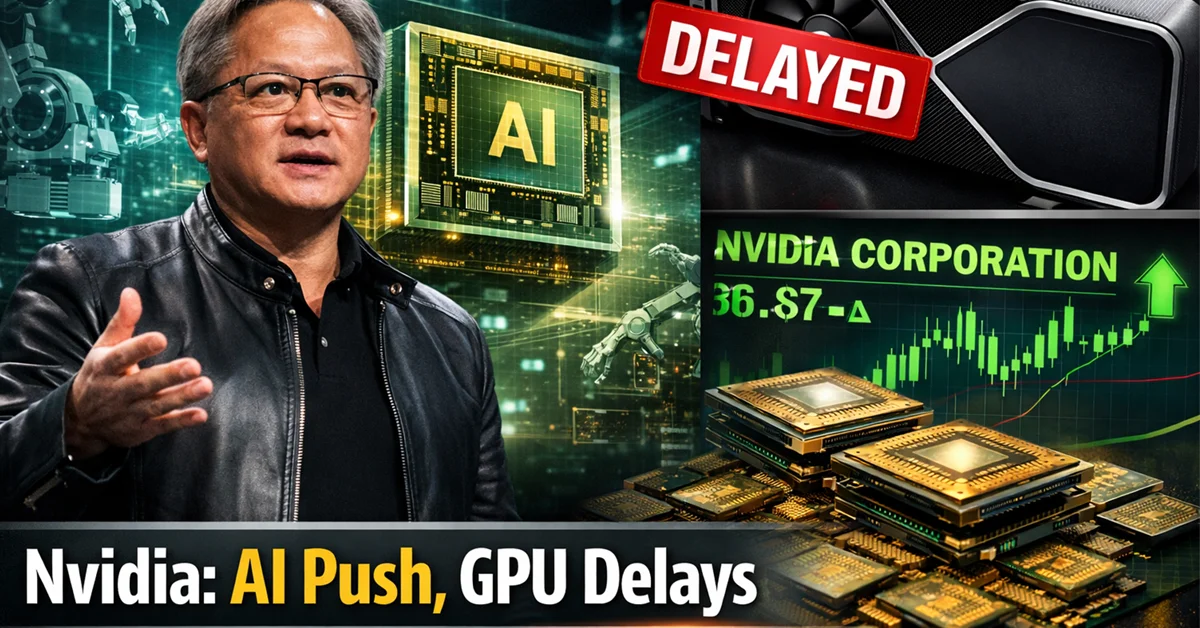
Nvidia unveiled new artificial intelligence technologies and posted strong financial results in recent months, even as industry reports indicate the company may delay launching new consumer gaming graphics cards until at least 2028 due to memory shortages and shifting priorities toward higher-margin AI hardware, according to company announcements and published reports.
At the Consumer Electronics Show in Las Vegas in January, Chief Executive Jensen Huang introduced the next-generation Vera Rubin AI platform and outlined advances across data-center computing, robotics, and autonomous systems. The platform is designed to deliver major gains in inference performance and efficiency and is expected to begin rolling out in the second half of 2026.
Nvidia also detailed updates to gaming software and displays, including DLSS 4.5 image-generation technology and new G-SYNC monitor capabilities intended to improve frame rates and visual clarity for GeForce RTX users. The company said more than 250 games and applications already support DLSS 4 features, with further releases planned.
Financial disclosures underscore the scale of Nvidia’s recent growth. The company reported record quarterly revenue of $57 billion in fiscal 2026, driven largely by demand for data-center products used in artificial intelligence workloads. Analysts have projected continued expansion in semiconductor spending and maintained bullish outlooks on Nvidia’s stock, citing its dominant position in AI training and inference infrastructure and expectations for additional product rollouts through 2026.
At the same time, multiple reports suggest Nvidia could forgo releasing new GeForce RTX gaming GPUs in 2026, marking a rare pause in its consumer graphics lineup. The delay is linked to global memory-chip constraints and the company’s focus on supplying higher-margin AI processors, with next-generation consumer GPUs potentially pushed to 2028. Some supply reductions for existing mid-range graphics cards have also been considered as memory shortages tighten production capacity.
The contrasting signals—rapid AI expansion alongside constrained consumer hardware—highlight Nvidia’s evolving strategy as demand for generative AI infrastructure reshapes the semiconductor industry. Upcoming chip launches tied to the Rubin architecture and continued data-center investment are expected to remain central to the company’s near-term trajectory.
ALSO READ: Michelle Yeoh To Receive Berlinale Honor As New Film Premieres

You can definitely see your expertise in the paintings you write. The sector hopes for even more passionate writers such as you who are not afraid to mention how they believe. All the time follow your heart. “Faith in the ability of a leader is of slight service unless it be united with faith in his justice.” by George Goethals.
интернет агентство продвижение сайтов сео интернет агентство продвижение сайтов сео .
комплексное продвижение сайтов москва prodvizhenie-sajtov-v-moskve16.ru .
555
555
555
555
555
555
I’ll immediately seize your rss as I can not in finding your e-mail subscription hyperlink or e-newsletter service. Do you’ve any? Please permit me realize in order that I may just subscribe. Thanks.