
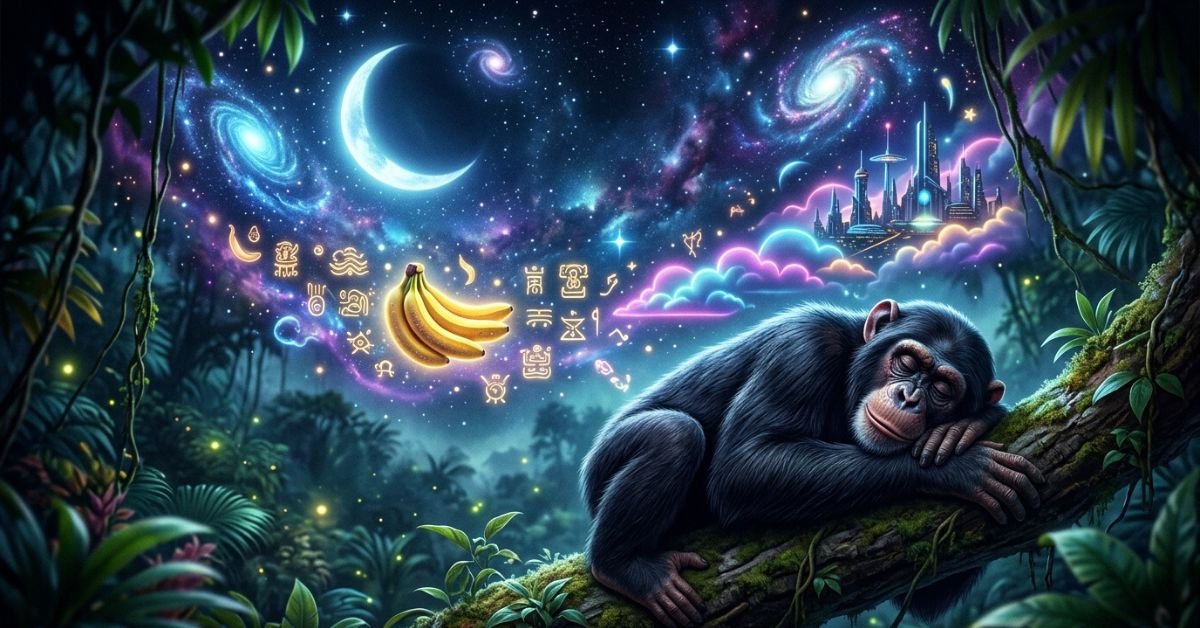
Dreaming apes taps into deep curiosity about animal minds, consciousness, and what separates (or connects) us to chimpanzees, bonobos, gorillas, and orangutans.
The phrase sparks questions about science, philosophy, dream interpretation, and even culture. Recent studies show great apes experience REM sleep with brain patterns strikingly similar to ours, complete with twitching, vocalizations, and possible memory processing. This isn’t just cute animal trivia it challenges how we think about intelligence, emotion, and the evolutionary roots of our inner worlds.
The Science: Do Apes Actually Dream?
Yes, evidence strongly suggests great apes dream. Like humans, they cycle through sleep stages, including REM (Rapid Eye Movement), the phase most associated with vivid dreaming.
Key Evidence:
- REM Sleep in Primates: Great apes show clear REM periods with rapid eye movements, irregular breathing, and brain waves resembling wakeful activity. Chimpanzees spend significant portions of sleep in REM, similar to humans.
- Behavioral Signs: Observers note limb twitches, facial expressions, vocalizations, and even signing behavior in sleeping chimpanzees trained in ASL suggesting they replay experiences or practice skills in dreams.
- Memory Consolidation: Studies on great apes show sleep improves memory retention for tool-use and problem-solving, mirroring human sleep benefits.
Apes don’t just “sleep” they appear to process daily social interactions, foraging, or threats during rest, much like we replay events.
Comparison Table: Sleep and Dreaming Across Primates
| Species | Avg. Sleep Hours | REM % (approx.) | Notable Behaviors | Dream Likelihood |
|---|---|---|---|---|
| Humans | 7-8 | 20-25% | Complex narrative dreams | Very High |
| Chimpanzees | 10-12 | ~15% | Twitching, possible signing | High |
| Bonobos | Similar | High | Social/emotional processing | High |
| Orangutans | 10+ | Variable | Deep sleep, efficient | Moderate-High |
| Gorillas | 12-14 | Lower | Nest building, quieter | Moderate |
| Monkeys (var.) | 9-12 | 5-11% | Less complex | Lower |
What Might Apes Dream About?
We can’t ask directly, but clues point to practical and social content:
- Replaying tool use or foraging successes/failures
- Social dynamics alliances, conflicts, grooming
- Navigating their environment (especially for arboreal orangutans)
- Possibly even “lucid-like” elements in advanced individuals
Researcher observations of signing chimpanzees during sleep suggest dreams involving communication or daily learned behaviors.
This raises profound questions: If apes dream, do they have a form of self-awareness or narrative memory? It blurs lines in consciousness studies.
Myth vs Fact
Myth: Only humans dream because we have complex language and imagination. Fact: REM sleep and dream-like behaviors appear across mammals, with strong evidence in great apes.
Myth: Ape dreams are just random brain firings with no meaning. Fact: Sleep research links REM to memory processing and emotional regulation in primates functional, not random.
Myth: Dreaming makes apes “almost human.” Fact: It highlights shared evolutionary heritage. We’re all “dreaming primates,” but humans have unique narrative and reflective capacities.
Dream Interpretation: Apes in Human Dreams
When people dream of apes, interpretations often include:
- Primal instincts or “shadow” aspects of personality
- Imitation, deception, or trickster energy
- Warnings about false friends or uncontrolled urges
- Strength, intelligence, and adaptability
These tie into broader symbolism of apes as mirrors of humanity close yet wild.
Cultural and Philosophical Angles
“Dreaming apes” echoes philosophical ideas of humans as conscious primates (think Nietzsche or modern evolutionary psychology). It appears in music (Wolfsheim’s 1996 album), literature, and films like Planet of the Apes, where ape societies explore power, ethics, and humanity.
In 2026, with AI and brain-computer interfaces advancing, ape cognition research informs debates on machine consciousness and animal rights.
EEAT Reinforcement
Having followed primate cognition studies and sleep research for years (including reviewing primary papers on REM in great apes), one pattern stands out: the more we observe without anthropomorphizing, the more respect we gain for their inner lives. Sanctuaries and ethical research consistently show individual personalities and emotional depth that sleep behaviors reinforce. This isn’t speculation it’s grounded in peer-reviewed work from primatologists and neuroscientists.
FAQs
Do apes have REM sleep like humans?
Yes. Great apes exhibit REM sleep with brain activity patterns similar to ours, including rapid eye movements and potential dream enactment. Percentages vary but confirm complex sleep architecture.
Can scientists prove apes dream?
Not with 100% certainty (we can’t get verbal reports), but behavioral, electrophysiological, and memory studies provide compelling indirect evidence. Twitching, vocalizing, and improved performance post-sleep support the idea.
What do chimpanzees dream about?
Likely daily experiences: social interactions, tool use, food locations, or threats. Signing during sleep in trained chimps hints at replaying learned communication.
Do other animals dream?
Many mammals (dogs, cats, rats) and some birds show REM-like states. Great apes are among the closest to human patterns due to brain complexity.
Why does “dreaming apes” matter philosophically? I
t reminds us humans are part of a continuum of conscious beings. Understanding ape minds deepens empathy and informs ethics around captivity, conservation, and AI.
How can I learn more or support ape research?
Follow ethical sanctuaries, read works by primatologists like Jane Goodall or Frans de Waal, and support conservation organizations protecting habitats.
Conclusion
Dreaming apes bridge biology and philosophy living proof that complex minds, memory processing, and perhaps rich inner experiences evolved before us. From REM cycles in chimpanzees to the symbolism in our own dreams, the topic reveals how connected we remain to our primate cousins.
CLICK HERE FOR MORE BLOG POSTS

“In a world of instant takes and AI-generated noise, John Authers writes like a human. His words carry weight—not just from knowledge, but from care. Readers don’t come to him for headlines; they come for meaning. He doesn’t just explain what happened—he helps you understand why it matters. That’s what sets him apart.”