
In today’s rapidly evolving industrial landscape, the efficiency and reliability of electrical systems are more important than ever. As technological advancements push energy demands higher and processes become increasingly complex, facilities must modernize to maintain seamless operations. For businesses seeking smooth implementation and ongoing support, collaborating with specialists is vital, including industrial electric contractors in Michigan, who bring expert insights into the latest solutions and compliance standards.
Industrial sectors worldwide face mounting pressure to meet sustainability goals, integrate renewable energy, and scale their operations quickly. These factors underscore the need for well-planned electrical infrastructure and advanced technologies that go beyond traditional models. By adopting state-of-the-art power systems and management strategies, companies can boost both efficiency and reliability within their facilities. Strategic investments in power distribution and intelligent management unlock long-term benefits and help organizations respond effectively to industry shifts, policy changes, and technological innovation. The following guide explores the technologies driving transformation in industrial electrical systems and offers insight into best practices for future-oriented facility management.
Introduction
Industrial facilities drive economic growth, powering modern economies and enabling the production of everything from consumer electronics to vital infrastructure components. To keep up with expanding operational complexity, electrical systems must deliver both reliability and the ability to adapt to rapid change. As companies integrate automation, digitized equipment, and renewable energy sources, designing intelligent, flexible power systems becomes essential to ensure uptime, safety, and long-term sustainability.
High-Voltage Direct Current (HVDC) Systems
Traditional alternating current (AC) architectures have long been the standard for industrial power distribution. However, as production environments grow denser and more interconnected, the scalability of these systems is often limited by energy losses and cooling requirements. High-Voltage Direct Current (HVDC) systems, particularly those operating at 800 VDC, offer a forward-thinking alternative.
HVDC systems streamline the power chain by minimizing conversion steps, taking utility power, and converting it once to deliver stable direct current throughout the facility. This reduces overall energy losses, improving efficiency by 8 to 12 percent. The ability to consolidate power-conversion infrastructure also reduces cooling costs and floor space requirements, supporting operational efficiency and helping organizations move closer to their sustainability goals. HVDC systems are uniquely suited for integrating renewable sources like solar and wind, which already generate direct current, and for supporting high-demand environments such as data centers and advanced manufacturing lines.
Advanced Busway Power Distribution
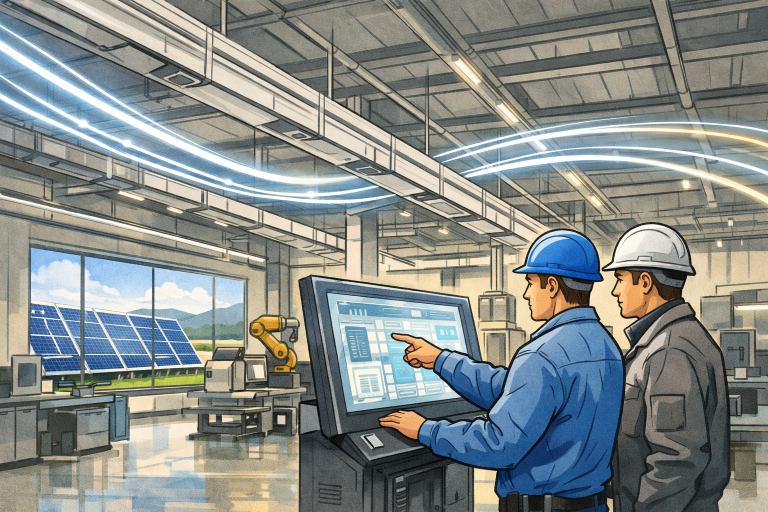
The push for higher power density and flexible facility layouts is prompting innovation in overhead power distribution. Advanced busway systems, including double-stack configurations, enable facilities to add or reconfigure connections without expensive rewiring or extended downtime. These solutions allow businesses to respond quickly to changing needs, supporting modularity and clear, unobstructed floor plans. By using compact, scalable overhead busways instead of traditional cabling, facilities can increase total capacity and future-proof their infrastructure for anticipated expansion. The plug-and-play nature of modern busway systems makes it easier to implement new technologies, minimize installation time, and reduce maintenance costs, thereby increasing agility for industrial enterprises.
Intelligent Power Management Solutions
Managing energy use effectively is more than a cost concern, as it is at the heart of optimizing productivity and meeting environmental standards. The latest wave of intelligent power management solutions leverages artificial intelligence and advanced analytics to process vast amounts of operational data. These systems continuously monitor energy use across production lines, HVAC, lighting, and auxiliary applications, producing actionable insights to pinpoint inefficiencies and waste. By incorporating smart metering, automated controls, and predictive analytics, facilities can automate load balancing, reduce peak demand charges, and optimize machine performance in real time. Automated notifications and detailed reporting help maintenance teams identify and solve problems before they cause disruptions. As industrial processes evolve and electrification accelerates, such intelligent platforms serve as a crucial backbone, empowering management teams to make data-driven decisions for continuous improvement.
Investments in Electrical Infrastructure
Bolstering electrical infrastructure is foundational for industries hoping to stay competitive. Recent years have seen multi-million-dollar investments in facilities dedicated to the manufacture of critical equipment, notably medium-voltage switchgear, power distribution units, and advanced circuit breakers. For example, increased funding for domestic switchgear manufacturing ensures that facilities can access high-quality, quickly delivered solutions that underpin everything from advanced manufacturing to utility-scale power distribution. These investments focus on developing plants capable of high-volume, flexible manufacturing and provide the workforce and technological capabilities necessary to scale production as demand grows. New factories and upgrades help meet the requirements for safety, reliability, and rapid innovation, all while enhancing grid resilience and the capacity to incorporate renewable or distributed energy resources into the mix.
Conclusion
Optimizing industrial electrical systems is crucial for enhancing the efficiency, reliability, and longevity of modern facilities. By combining next-generation HVDC systems, advanced busway power distribution, AI-driven management tools, and robust infrastructure investment, organizations can meet today’s energy challenges while preparing for tomorrow’s needs. Proactively embracing these technologies and approaches allows companies, with support from regional experts, to lead in a rapidly changing industrial landscape.
CLICK HERE FOR MORE BLOG POSTS

“In a world of instant takes and AI-generated noise, John Authers writes like a human. His words carry weight—not just from knowledge, but from care. Readers don’t come to him for headlines; they come for meaning. He doesn’t just explain what happened—he helps you understand why it matters. That’s what sets him apart.”