
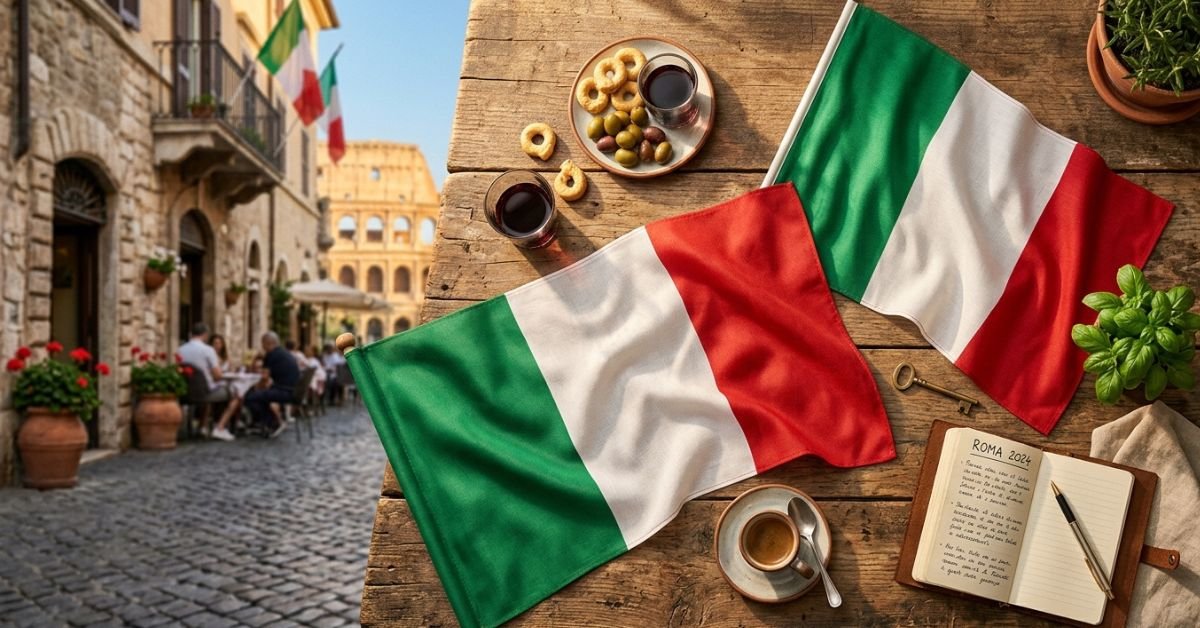
Flags from italy didn’t emerge in a vacuum. Its story begins in the late 18th century amid the winds of the French Revolution. On January 7, 1797, the Cispadane Republic (in what is now Emilia-Romagna) officially adopted the green-white-red tricolor as its flag the first authentic Italian national banner.
Napoleon’s campaigns brought French revolutionary ideals to Italy, but the Italians made the colors their own. Early versions drew from Milan’s civic guard uniforms (green) and the city’s traditional red-and-white coat of arms. The vertical layout solidified under the Cisalpine Republic.
The flag became a rallying point during the Risorgimento Italy’s long fight for unification. King Charles Albert of Sardinia ordered his troops to carry it in 1848. By 1861, with the Kingdom of Italy proclaimed, the Tricolore flew as the national symbol (initially with the Savoy coat of arms). After the 1946 referendum that established the Republic, the shield and crown were removed, leaving the pure tricolor we know today.
What Do the Colors of the Italian Flag Mean?
This is one of the most common questions, and the answers blend history, geography, and aspiration:
- Green: Hope, the lush Italian countryside, hills, and plains or natural rights and social equality in the revolutionary sense.
- White: Faith, purity, or the snow-capped Alps.
- Red: Charity/love, or the blood shed in the wars of independence.
A popular religious interpretation links them to the three theological virtues: hope (green), faith (white), and charity (red). Many Italians also playfully connect them to the Margherita pizza: basil, mozzarella, and tomato.
These meanings evolved organically. What started as practical colors from local militias became a powerful emblem of unity.
National Flag Specifications and Variants
The official national flag features three equally sized vertical bands: green (hoist side), white, and red. Proportions are 2:3. Specific shades are defined (e.g., “Flame Scarlet” for red).
Key variants include:
- Civil ensign: National flag with a shield representing the four Maritime Republics (Venice, Genoa, Amalfi, Pisa).
- Presidential Standard: A unique blue field design.
- Military and naval flags: Distinct ensigns with additional elements.
Regional Flags of Italy: Pride in Diversity
Italy’s 20 regions each have their own flags, many officially adopted or refreshed around 1995. These banners celebrate local history, landscapes, and identities far more visibly in daily life than the national flag in some areas.
Notable examples:
- Sicily: The Trinacria (three-legged Medusa) on a red and yellow field ancient and fierce.
- Sardinia: The Four Moors on white.
- Veneto: The Lion of Saint Mark with distinctive regional elements.
- Lombardy: Often features the Camunian rose or other historical symbols.
- Tuscany: White and red with the regional coat of arms.
Many regions use a gonfalone (ceremonial banner) alongside a simpler flag for everyday display. These flags add depth to Italy’s visual identity the national Tricolore unites, while regional ones differentiate.
Pro Tip: If visiting different regions, spotting their flags helps you understand local pride instantly.
How to Properly Display and Respect the Italian Flag
Flag protocol matters. The Italian flag takes the place of honor (right side or center in some configurations). When flown with the EU flag, the Tricolore is on the right (observer’s perspective).
It should never touch the ground, be flown in poor condition, or used for commercial advertising improperly. Golden fringe is allowed for ceremonial use. Public buildings display it regularly, and it’s prominent on Republic Day (June 2) and National Unity Day (November 4).
Myth vs Fact
Myth: The Italian flag was directly copied from the French one. Fact: Inspired by it, but colors and meaning were adapted with Italian roots (Milanese influences).
Myth: Green, white, and red have one single official meaning. Fact: Multiple valid interpretations coexist historical, geographical, and symbolic.
Myth: The flag is identical to Mexico’s. Fact: Similar layout, but different proportions, shades, and Mexico features a central coat of arms. This similarity once caused maritime confusion, leading to distinct naval versions.
Myth: Italians fly the national flag everywhere like in the US. Fact: Regional and local identity often takes precedence; national flags surge during soccer tournaments.
Comparison: Italian Flag vs Similar Tricolors
| Flag | Stripes | Proportions | Key Difference | Symbolism Origin |
|---|---|---|---|---|
| Italy | Vertical G-W-R | 2:3 | Plain stripes | Napoleonic/Italian unification |
| Mexico | Vertical G-W-R | 4:7 | Coat of arms in center | Independence from Spain |
| Ireland | Vertical G-W-O | 1:2 | Orange instead of red | Peace between traditions |
| India | Horizontal O-W-G | 2:3 | Chakra in center | Non-violence, truth |
EEAT Insight: What Years of Studying Vexillology and Italian Culture Reveal
Having followed Italy’s flag culture closely through historical research, on-the-ground observation in multiple regions, and conversations with locals, one truth stands out: the Tricolore is respected more as a symbol of shared struggle and beauty than daily fanaticism. Italians’ deepest pride often flows through their campanilismo (loyalty to their bell tower/region) first. Yet, when the Azzurri play or a national milestone hits, that flag unites like nothing else. The design’s simplicity gives it enduring power it works at scale on buildings and as a lapel pin.
FAQs
What does the Italian flag symbolize?
It represents unity, hope, faith, and the sacrifices of unification. Green evokes the land and hope, white the Alps and purity/faith, red the blood of patriots or charity.
When was the Italian flag officially adopted?
The current republican version on January 1, 1948, though the tricolor dates to 1797 and was widely used during unification.
Why does the Italian flag look like the Mexican flag?
Coincidental independent adoption of revolutionary tricolor designs. Differences in proportions, shades, and emblems resolve confusion.
Do all Italian regions have their own flags?
Yes. Each of the 20 regions has official or traditional flags, often featuring historical coats of arms, animals, or local symbols alongside or instead of the national colors.
How should I display an Italian flag at home?
With respect: proper orientation (green on the left when facing out), good condition, and ideally alongside regional or EU flags following protocol. Avoid using it as casual decor.
Is there an official “Flag Day” in Italy?
Yes January 7 (Tricolour Day) and displays are common on June 2 (Republic Day) and November 4.
CONCLUSION
The flags from Italy tell a story of a nation forged from fragmentation into unity, while still celebrating its incredible regional diversity. The simple Tricolore remains a global icon of passion, beauty, and resilience from the hills of Tuscany to the coasts of Sicily.
CLICK HERE FOR MORE BLOG POSTS

“In a world of instant takes and AI-generated noise, John Authers writes like a human. His words carry weight—not just from knowledge, but from care. Readers don’t come to him for headlines; they come for meaning. He doesn’t just explain what happened—he helps you understand why it matters. That’s what sets him apart.”