
Isopods belong to the order Isopoda within the class Malacostraca the same group that includes crabs, lobsters, and shrimp. The name comes from Greek for “equal foot,” referring to their seven pairs of nearly identical legs.
Key shared features across the roughly 10,000+ described species:
- Segmented body: Head (cephalon), thorax (pereon with 7 segments), and abdomen (pleon).
- Exoskeleton: Rigid, chitinous plates that they molt periodically.
- Respiration: Most terrestrial species have modified gills (pleopodal lungs) on their underside, which is why they need moisture.
- Antennae and mouthparts: Two pairs of antennae and specialized jaws for varied diets.
- Brooding: Females carry eggs and young in a marsupium pouch under the thorax.
Unlike insects, they are true crustaceans. This means they’re more closely related to a lobster than to a beetle, despite the similar appearance.
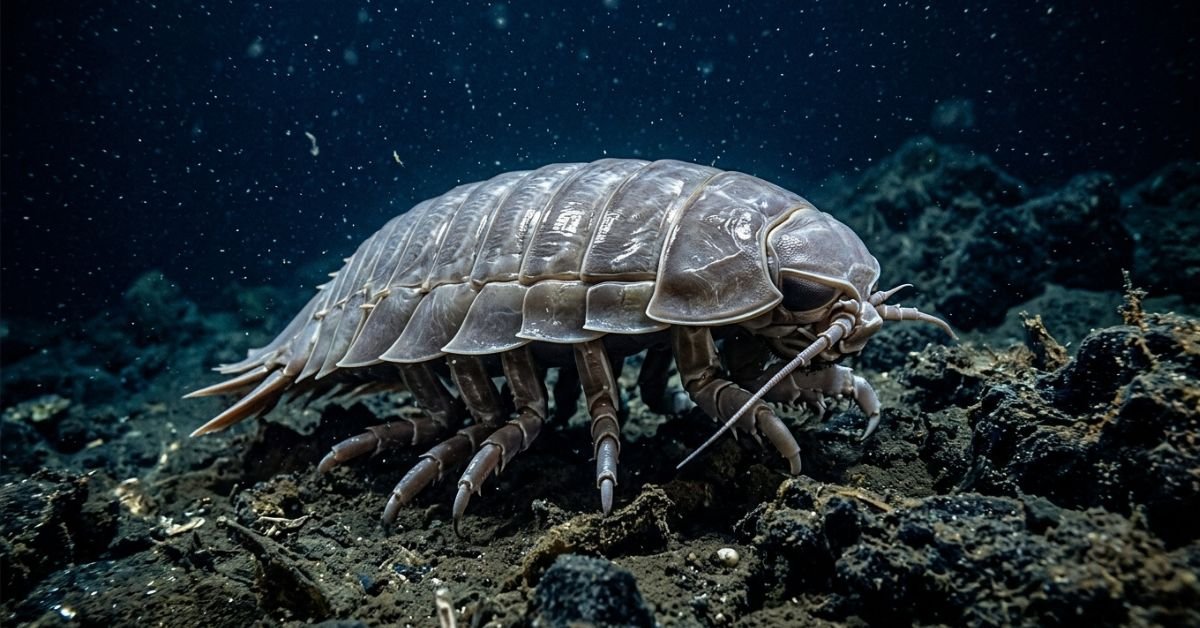
They range from microscopic deep-sea dwellers to the famous giant isopods reaching over 16 inches (40 cm). Most are detritivores or scavengers, playing a vital cleanup role.
Terrestrial Isopods: The Ones You Know Best
The isopods most people encounter are the terrestrial ones commonly called woodlice, pill bugs, roly-polies, or sow bugs.
- Pill bugs (e.g., Armadillidium vulgare): Can roll into a perfect ball for defense.
- Sow bugs (e.g., Porcellio scaber): Similar but generally cannot roll fully.
Why they matter in your garden: They break down decaying organic matter, recycling nutrients back into the soil. They’re harmless to living plants in healthy numbers and indicate good moisture and organic content.
They breathe through gills, so you’ll find them in damp, dark spots under rocks, mulch, or logs. This moisture dependence is why they’re often mistaken for insects that have “invaded” homes they’re actually just seeking humidity.
Aquatic and Deep-Sea Isopods: The Hidden Majority
While terrestrial species get the attention, the majority of isopods are marine. They inhabit everything from shallow coasts to the abyssal plains.
Giant Isopods (Bathynomus genus) steal the show. These deep-sea scavengers can grow to impressive sizes due to deep-sea gigantism. They survive crushing pressure, total darkness, and scarce food by being opportunistic they’ll wait years between meals, scavenging whale falls, fish carcasses, and whatever sinks.
Recent observations (including submersible footage) show they’re surprisingly active for their size and play a key role in nutrient cycling on the ocean floor.
Isopods as Pets and Cleanup Crews: The 2026 Hobby Boom
In the bioactive terrarium and reptile hobby, isopods have exploded in popularity. They serve as a living cleanup crew, eating leftover food, waste, mold, and leaf litter while aerating substrate.
Popular species for keepers:
- Armadillidium vulgare (classic pill bug) – Hardy, rolls up.
- Porcellio scaber (Dairy Cow, Spanish Orange morphs) – Fast breeders, active.
- Trichorhina tomentosa (Dwarf White) – Tiny, great for small setups.
- Cubaris species and “powder blues/oranges” – Trending for unique colors and behaviors.
Basic Care Essentials (for a thriving culture):
- Enclosure: Ventilated container or section of terrarium, 1+ gallon for starters.
- Substrate: Mix of soil, coco coir, leaf litter, charcoal, and bark. Depth 2-4 inches.
- Humidity: 60-80%+; mist as needed. They need moisture but good airflow to prevent mold overload.
- Temperature: Most do well at 65-75°F (18-24°C). Avoid extremes.
- Food: Leaf litter (oak, maple, etc.), vegetables, protein (fish flakes, shrimp pellets), cuttlebone or calcium sources for molting.
- Hides: Cork bark, stones, moss.
Pro Tip from hands-on experience: Overfeeding protein can cause population booms followed by crashes if moisture dips. A balanced, naturalistic setup with varied leaf litter usually self-regulates best. Cultures can explode healthily in well-established bioactive vivariums.
Comparison Table: Common Isopod Types
| Type | Size | Rolling Ability | Best For | Activity Level | Notes |
|---|---|---|---|---|---|
| Armadillidium | Small-Med | Excellent | Beginners, bioactive | Moderate | Classic roly-poly |
| Porcellio | Small-Med | Poor | Cleanup crews, breeding | High | Many colorful morphs |
| Cubaris spp. | Small | Good | Display, collectors | Variable | Often more “personality” |
| Giant (Bathynomus) | Huge | None | Aquariums, education | Low | Deep-sea, not for home keeping |
| Dwarf White | Tiny | None | Micro setups, feeders | Very High | Can be too prolific |
Myth vs Fact
Myth: Isopods are insects. Fact: They’re crustaceans. They have more in common with shrimp than beetles.
Myth: They damage healthy plants. Fact: They primarily eat decaying matter. Significant plant damage usually signals an underlying issue like overwatering or poor drainage.
Myth: All isopods can roll into balls. Fact: Only certain terrestrial genera (like Armadillidium) do this effectively.
Myth: Giant isopods are dangerous predators. Fact: They’re mostly scavengers. Their size is an adaptation to extreme deep-sea conditions, not aggression.
Statistics and Ecological Importance
- Over 10,000 described species, with estimates of many more undiscovered.
- Terrestrial isopods help process massive amounts of detritus annually in forests and gardens.
- In captivity, a healthy culture can process leftover feeder insect waste and maintain bioactive balance better than manual cleaning alone.
Their success across habitats deserts to Antarctic waters showcases incredible evolutionary adaptability.
FAQs
What do isopods eat?
Primarily decaying plant matter, but they also consume mold, animal waste, and occasional protein. In the wild and in captivity, variety is key for health.
How long do isopods live?
Most terrestrial species live 2–4 years with good care, though some larger or slower-growing types can live longer.
Can isopods bite or harm humans?
They are completely harmless to people and pets. They don’t sting, bite, or carry diseases.
Do isopods need light?
They prefer darkness or low light. Bright light stresses them and dries out their environment.
Are isopods good for bioactive terrariums?
Excellent. They’re one of the best cleanup crews available, working alongside springtails for a self-sustaining micro-ecosystem.
Where can I buy isopods?
Specialty reptile and bioactive suppliers offer starter cultures with good genetics and morphs. Always choose reputable sources with live arrival guarantees.
CONCLUSION
From the humble roly-poly in your garden to the mysterious giants patrolling the ocean floor, isopods demonstrate nature’s genius for filling niches. They recycle nutrients, support complex food webs, and have become beloved (and useful) companions in modern hobbyist setups.
CLICK HERE FOR MORE BLOG POSTS

“In a world of instant takes and AI-generated noise, John Authers writes like a human. His words carry weight—not just from knowledge, but from care. Readers don’t come to him for headlines; they come for meaning. He doesn’t just explain what happened—he helps you understand why it matters. That’s what sets him apart.”