

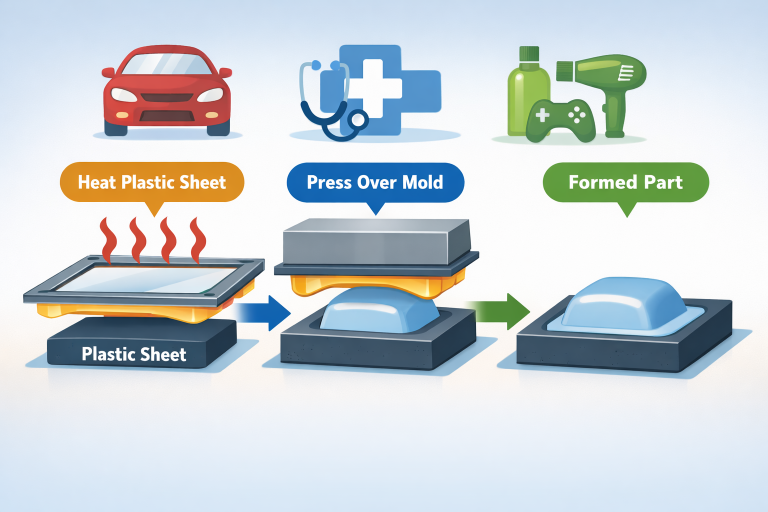
Thermoforming is a reliable and highly adaptable manufacturing process in which a plastic sheet is heated to a pliable state, then shaped over a custom mold, and finally trimmed into a finished product. This method is particularly popular across a wide array of industries because of its ability to deliver consistent quality and prototype versatility. For companies seeking personalized solutions for their production needs, https://npi-ks.com/services/custom-thermoforming/ offers a comprehensive overview of available custom thermoforming services and techniques.
As businesses face growing demands for efficiency and scalability, thermoforming remains a preferred choice for its speed and economic advantages. The process not only transforms basic plastic sheets into complex parts but also allows manufacturers to respond swiftly to changing design requirements. This adaptability makes thermoforming an increasingly sought-after technique for industries aiming for both rapid product development and high-quality output.
Advantages of Custom Thermoforming
There are several compelling advantages for manufacturers who adopt custom thermoforming:
- Design Flexibility: Thermoforming opens the door to imaginative designs, including intricate shapes, deep draws, and detailed surface textures. This flexibility means products can be fully tailored to precise client or industry specifications.
- Cost Efficiency: Compared with other plastic forming methods, such as injection molding, thermoforming consistently delivers lower tooling costs. These savings can be significant, especially for small-to-medium production runs or when frequent design changes are anticipated.
- Rapid Prototyping: Because the thermoforming process is less tooling-intensive, companies can move from design to prototype and ultimately to production within tight lead times, giving a vital competitive edge.
Applications Across Industries
Thermoforming is widely used across diverse sectors. In the automotive industry, for example, it is utilized to produce interior panels, dashboards, and protective coverings. The medical sector relies extensively on custom thermoformed packaging solutions, such as sterile trays and blister packs, to maintain product safety and meet rigorous compliance standards. Consumer goods manufacturers also leverage thermoforming to create everything from packaging inserts and appliance housings to point-of-purchase displays.
Its broad application demonstrates the process’s value not only for its design adaptability, but also its reliability under stringent production and safety requirements.
Technological Advancements in Thermoforming
In recent years, technological advancements have significantly improved the thermoforming process. Sophisticated machines equipped with digital controls now facilitate precise monitoring of heat and pressure, ensuring consistent product thickness and dimensional accuracy. Automated systems reduce manual labor requirements, while robotics enable high-speed trimming, drilling, and finishing operations, further streamlining production.
Advanced simulation software now assists engineers during mold and prototype development. These digital tools help anticipate challenges such as warping, thinning, or uneven cooling before manufacturing even begins, which effectively minimizes costly errors and material waste.
Material Selection and Sustainability
Material selection plays a critical role in a finished product’s performance, appearance, and environmental impact. Today, manufacturers can select from a wide variety of plastics, including ABS, polystyrene, PETG, and increasingly, recycled or biodegradable options. Sustainable material choices have become more accessible as advances in plastic chemistry continue. This not only helps organizations meet growing environmental mandates but also appeals to environmentally conscious consumers.
Manufacturers also benefit from processes such as closed-loop recycling, in which scrap materials and offcuts are reclaimed and reintroduced into the production cycle. According to the American Chemistry Council, closed-loop systems can significantly reduce overall plastic waste in manufacturing.
Design Considerations for Thermoformed Products
Successful thermoformed products are rooted in thoughtful design that takes into account the specific behaviors of plastic material. Effective walls should remain as uniform as possible to maintain part strength and consistency. Incorporating adequate draft angles supports easy removal from molds, while careful prediction of material shrinkage ensures the finished dimensions are as intended.
- Uniform thickness prevents weaknesses or stress points.
- Draft angles facilitate seamless release from molds.
- Clear consideration of shrinkage maintains the integrity of the product’s final shape.
Comparing Thermoforming to Other Manufacturing Methods
Thermoforming, compared to alternatives such as injection molding or blow molding, offers clear advantages throughout the product development cycle. Initial investments in mold tooling are markedly lower, and the setup timeline is shorter. This makes thermoforming an excellent option for short-to-medium production runs or for projects that may require frequent design modifications.
Injection molding, while suitable for high-volume production, often demands more complex tooling and a longer development timeline. For organizations weighing their options, understanding the total cost and flexibility requirements is key to making the best manufacturing decision.
Future Trends in Thermoforming
The future of thermoforming involves ongoing automation, digital transformation, adaptive machinery, AI for real-time monitoring, and better data analytics to improve quality and reduce waste. Development of recyclable and compostable materials will boost sustainability. As manufacturers adopt these advancements, thermoforming will prove even more valuable for creating innovative, cost-effective, and sustainable solutions, making it a crucial method in modern manufacturing to meet new challenges and opportunities.
CLICK HERE FOR MORE BLOG POSTS

“In a world of instant takes and AI-generated noise, John Authers writes like a human. His words carry weight—not just from knowledge, but from care. Readers don’t come to him for headlines; they come for meaning. He doesn’t just explain what happened—he helps you understand why it matters. That’s what sets him apart.”