
Florida state flag was officially adopted on November 6, 1900, and refined in 1985. Its design blends practical history, cultural symbolism, and a touch of pragmatic politics. In this deep-dive pillar guide, we’ll break down the exact design, the stories behind every element, the full evolution of Florida’s flags, and what it all means today. Whether you’re a proud Floridian, a history buff, or just curious why that red cross is there, you’ll walk away with the kind of context that turns a simple flag into a story worth telling.
What Does the Florida Flag Look Like
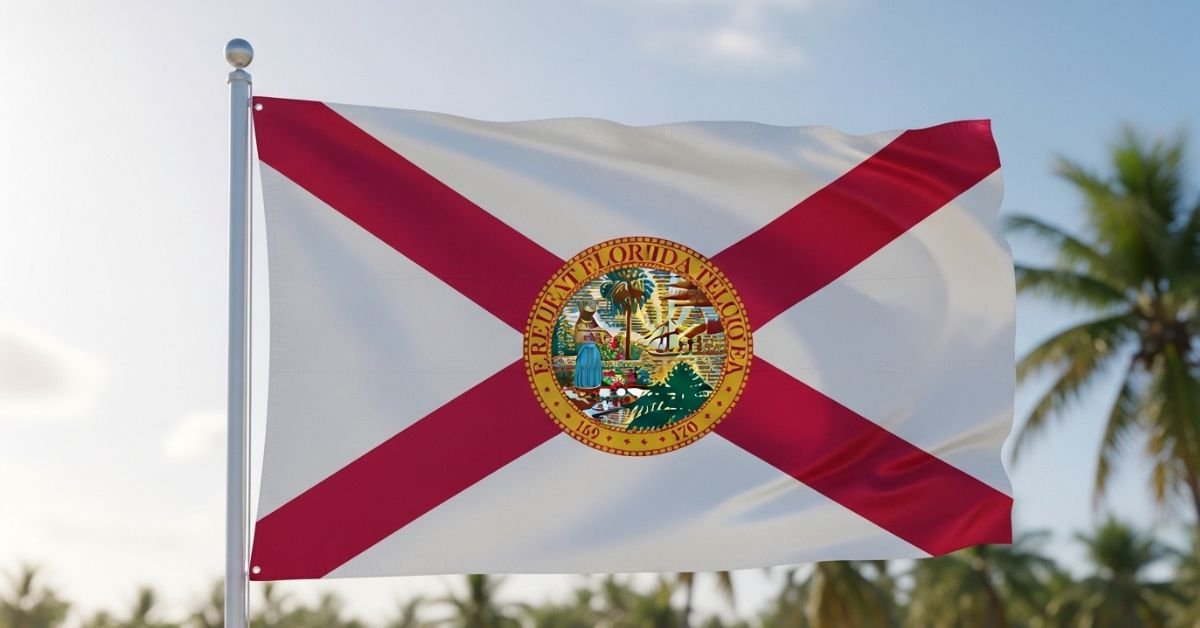
The Florida state flag is instantly recognizable: a white field (background) with a red saltire that’s the technical term for a diagonal X-shaped cross stretching from corner to corner. Right in the center sits the full-color Great Seal of the State of Florida.
- Proportions: 2:3 (standard for most U.S. state flags).
- Red bars: Each is one-fifth the width of the hoist (the side attached to the pole) and stops exactly at the outer edge of the seal so the seal remains fully visible.
- The seal diameter: Exactly half the height of the flag.
Official statute language (Florida Statutes § 15.012) puts it plainly: “The seal of the state, in diameter one-half the hoist, shall occupy the center of a white ground. Red bars, in width one-fifth the hoist, shall extend from each corner toward the center, to the outer rim of the seal.”
Simple, distinctive, and built to stand out whether it’s whipping in a coastal breeze or hanging still.
The Heart of the Flag: Florida’s State Seal Explained
The seal isn’t just decoration it’s the flag’s narrative core. The current version was standardized on May 21, 1985, by Governor Bob Graham and the Cabinet after artist John Locastro refined earlier inaccuracies.
Key elements you’ll see in the seal:
- Seminole woman scattering flowers: Represents Florida’s Indigenous heritage and the hospitality of the land.
- Sabal palmetto palm tree: Florida’s official state tree, symbolizing resilience and native flora.
- Steamboat on the water: Honors early commerce, trade, and transportation that helped build the state.
- Sun’s rays over distant highlands: Captures Florida’s legendary sunshine and varied landscape.
- Encircling text: “Great Seal of the State of Florida: In God We Trust” one of only three U.S. state flags to feature the national motto.
The 1985 update fixed historical quirks (goodbye, cocoa palm; hello, accurate sabal palmetto) and gave the seal a cleaner, more authentic look that still flies today.
A Timeline of Florida’s Flags: 180+ Years of Evolution
Florida hasn’t always flown the same banner. Here’s how it changed with the times:
| Year | Flag Design | Key Context |
|---|---|---|
| 1845 | Five horizontal stripes (blue, orange, red, white, green) + “Let Us Alone” ribbon + U.S. flag canton | Adopted at first governor’s inauguration; strong states’ rights message. Rarely used. |
| Jan 1861 | 13 red/white stripes + white star on blue canton | Secession-era provisional flag. |
| Sep 1861 | Red-white-red stripes + blue vertical bar with seal | Confederate “Stars and Bars” influence during Civil War. |
| 1868–1900 | White field with state seal only | Post-Civil War; Florida’s first truly independent state flag. |
| 1900–1985 | White field + red saltire + seal | Current design adopted by voter referendum. |
| 1985–present | Same design, standardized seal | Artistic update for accuracy and clarity. |
The leap from the plain-white 1868 flag to the 1900 version with the red saltire was the most significant visual shift and the one that still sparks conversation.
The Symbolism Behind Every Element
The red saltire carries layers. Officially, Governor Francis P. Fleming (a Confederate veteran) suggested it in the late 1890s so the flag wouldn’t look like a white flag of surrender when hanging limp on a still day. Some historians also point to the Spanish Cross of Burgundy that flew over colonial Florida from 1565–1763 a red sawtooth saltire on white that symbolized Spanish rule in the New World.
The white field evokes purity and peace. The seal ties everything back to Florida’s natural beauty, Indigenous roots, commerce, and faith.
Together, the design tells a story of resilience: a state that survived colonization, secession, Reconstruction, and hurricanes, yet still flies a flag that feels uniquely its own.
Myth vs Fact
Myth: The Florida flag is just a Confederate battle flag with a seal slapped on it. Fact: While the red saltire visually echoes the Confederate Army of Northern Virginia’s battle flag (and Alabama’s 1895 design), the documented reason was practical avoiding the “surrender” look and may reference Spanish colonial heritage. Legislative records from the era are sparse, but the official state narrative emphasizes the anti-surrender rationale.
Myth: The seal hasn’t changed since 1868. Fact: The artistic details were refined in 1985 for historical accuracy.
Myth: Only history nerds care about state flags. Fact: In 2023, Florida expanded homeowners’ rights to fly the state flag (along with the U.S. flag and others) regardless of HOA rules proof that symbols still matter in everyday life.
How Floridians Fly the Flag Today: Protocol and Modern Use
Florida follows the U.S. Flag Code but has its own governor’s protocol for half-staff observances. The state flag flies alongside the Stars and Stripes on every public building. You’ll see it at sporting events, festivals, and increasingly in private yards thanks to recent pro-flag legislation.
Pro tip: When displayed with the U.S. flag, the national flag always takes the position of honor (to the right or higher).
Insights from the Sources Drawing directly from the Florida Department of State’s official records and the 1985 standardization under Governor Bob Graham, this design has held strong for 125+ years because it works. It’s distinctive enough to spot from a distance, rich enough to reward closer inspection, and flexible enough to represent a state that keeps growing.
FAQs
What does the red X on the Florida flag mean?
The red saltire (diagonal cross) was added in 1900 primarily so the flag wouldn’t resemble a white flag of truce when hanging still. It may also nod to the historic Cross of Burgundy from Spanish colonial Florida.
When was the Florida state flag adopted?
November 6, 1900, by popular vote. The seal was standardized in its current form on May 21, 1985.
Is the Florida flag based on the Confederate flag?
It shares a visual similarity with the Confederate battle flag, but the documented intent was practical (avoiding the surrender look) rather than purely commemorative. Historians continue to debate Spanish versus Confederate influences.
What do the symbols in the Florida state seal represent?
The Seminole woman stands for Indigenous heritage and hospitality; the sabal palm for native strength; the steamboat for commerce; the sun for Florida’s climate; and “In God We Trust” as the state and national motto.
Can I fly the Florida flag at my house?
Absolutely and recent state law protects your right to display it even against strict HOA rules.
Has the Florida flag changed recently?
The design has remained consistent since the 1985 seal update.
CONCLUSION
Spanish colonial roots through statehood, Civil War, and into the 21st century, Florida’s flag has quietly evolved while keeping its core identity intact. It’s not flashy like some newer state flags, but that’s the point it feels timeless because it is timeless.Next time you spot that red saltire snapping in the Florida wind, you’ll see more than fabric. You’ll see a state that remembers where it came from while charging full speed into tomorrow.
CLICK HERE FOR MORE BLOG POSTS

“In a world of instant takes and AI-generated noise, John Authers writes like a human. His words carry weight—not just from knowledge, but from care. Readers don’t come to him for headlines; they come for meaning. He doesn’t just explain what happened—he helps you understand why it matters. That’s what sets him apart.”