
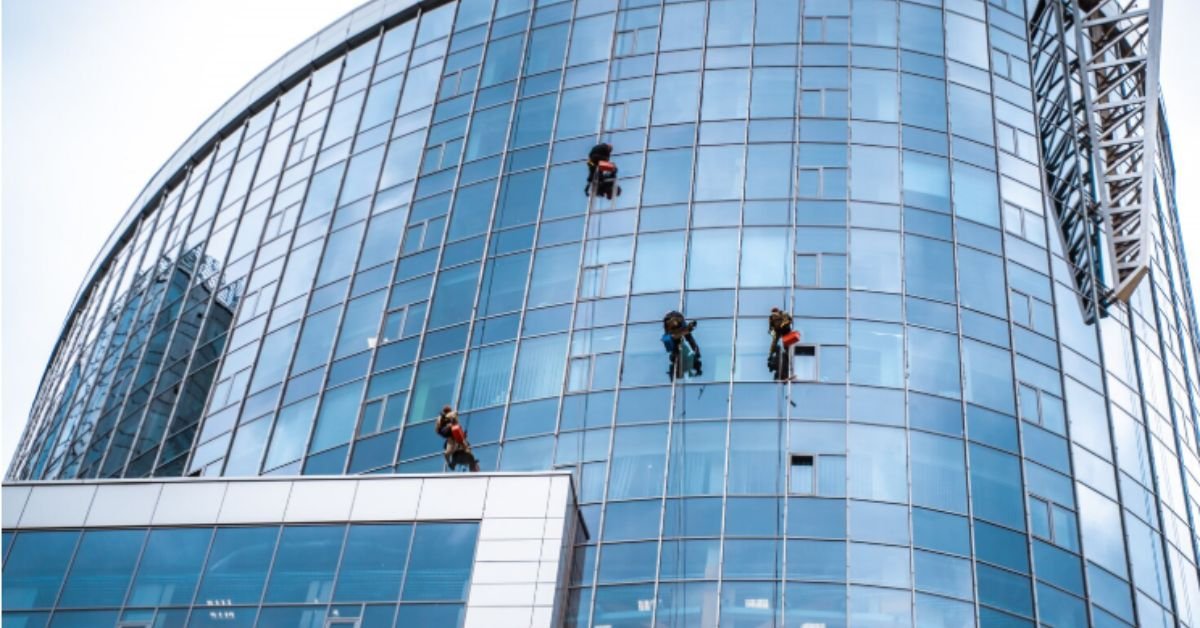
A Job That Starts Where the Elevator Stops
Picture this. It’s 6 a.m., the city is still rubbing sleep from its eyes, and somewhere forty floors up a person is dangling off the side of a glass tower with a squeegee in hand. No desk. No coffee break with a swivel chair. Just wind, glass, and a rope holding the whole story together.
Most of us never think about it. Glance up at a sparkling skyscraper and the windows seem to clean themselves, like magic, or rain, or some quiet building fairy. They don’t. The truth is that window washing high rise buildings is a craft mixing physics, nerve, and a frankly absurd amount of preparation, all hidden behind that mirror-like shine.
And the stakes? Higher than the building.
Why Height Changes Everything
On the ground, cleaning a window is a Saturday chore. Spray, wipe, complain, repeat. Lift that same task hundreds of feet into the air and it becomes a different animal entirely. Wind speed doubles. A dropped tool turns into a projectile. A smear you’d ignore at home becomes a streak visible from three blocks away.
This work is governed less by elbow grease and more by engineering. Crews study weather charts the way pilots do. They calculate load limits. They inspect anchor points that most office workers will never know exist, bolted quietly into the roof above their heads.
There’s a reason this trade takes safety so seriously. Industry reporting suggests high-rise work accounts for roughly a quarter of all fatalities in the window cleaning sector – a sobering number for a job that looks, from the sidewalk, almost peaceful. Workers’ compensation rates for high-rise crews can climb past $15 for every $100 of payroll, which tells you exactly how the insurance world reads the risk.
Friedrich Nietzsche once wrote that “he who would learn to fly one day must first learn to stand and walk and run and climb.” Window technicians live that sentence literally. Nobody straps into a harness on day one.
The Three Ways Up
So how does a person actually reach the 50th-floor glass? There are a few standard methods, and each has its own personality.
- Suspended platforms (BMUs). Those motorized cradles you sometimes spot gliding down a facade. They’re tethered to a Building Maintenance Unit on the roof – basically a crane built to babysit cleaners.
- Rope access. The dramatic one. Technicians rappel down on two independent ropes, one for working and one purely as backup. Borrowed straight from mountaineering.
- Water-fed poles. For lower floors, long telescopic poles fed with purified water do the trick from the ground. Less cinematic, very effective.
Each method demands its own certification, its own gear checks, its own rhythm. Pick the wrong one for a building and you’ve made the job slower, costlier, and a lot more dangerous.
Gear That Earns Its Keep
Ask any veteran what keeps them alive up there, and they’ll point to the unglamorous stuff. The rope. The harness. The descender. The helmet that looks dorky until the day it doesn’t.
Here’s the short list of what a serious high-rise kit usually includes:
- A full-body harness, inspected before every single descent
- Two ropes – one to work from, one to fall on (figuratively, please)
- A backup fall-arrest device that grabs the line if things go sideways
- Squeegees, scrapers, and microfiber that would make a perfectionist weep
- Purified or deionized water, because tap water leaves spots that haunt glass
Notice something? Cleaning tools come last. The first half of that list exists for one reason – so the person comes home for dinner.
The Part Nobody Sees
Cleaning glass at altitude isn’t just about staying safe. It’s about doing genuinely good work while the wind tries to argue with you.
Pure water matters more than people expect. Regular water carries minerals, and minerals dry into those ghostly white spots. That’s why crews lug deionized water up the side of buildings – it dries clean, no streaks, no residue, no callbacks.
Then there’s technique. A good technician reads the glass like a page. Top to bottom. Overlapping strokes. Watching for the exact moment the squeegee blade starts to drag instead of glide, which means it’s time for a fresh edge. Small details. Enormous difference.
In the internet’s telling, the global window cleaning market sat somewhere around $15 billion a few years back and is climbing toward nearly double that within the decade. A chunk of that growth is being pushed by demand for certified, properly trained high-rise teams – reportedly up more than 20% as buildings get taller and regulators get stricter. Turns out “anyone with a bucket” stopped being an acceptable answer a long time ago.
A Strange Kind of Calm
Talk to people who do this for a living and you hear something unexpected. Not fear. Focus.
The high-wire artist Philippe Petit, who famously walked between the Twin Towers, said that “limits exist only in the souls of those who do not dream.” Window technicians aren’t dreamers exactly – they’re meticulous, methodical, allergic to surprises. But there’s a shared thread. Up there, distractions fall away. The to-do list shrinks to one rope, one pane, one stroke at a time.
Agree that’s a weirdly peaceful way to spend a Tuesday? Maybe. Maybe not. Either way, the next time sunlight bounces off a flawless office tower, you’ll know what it cost to get it that clean.
What It All Comes Down To
High-rise window washing is one of those trades hiding in plain sight – essential, invisible, and a lot more technical than it looks from a café table.
It runs on three things, really:
- Respect for the height, which means safety before speed, every time
- The right method and gear, matched to the building rather than to habit
- Craft, the unfashionable kind that shows up in streak-free glass and zero shortcuts
So here’s a small dare. Look up tomorrow. Find the shiniest building on your block. Somewhere behind that gleam is a person who treated gravity with respect and won. Quietly. Forty floors above the noise.
CLICK HERE FOR MORE BLOG POSTS
