
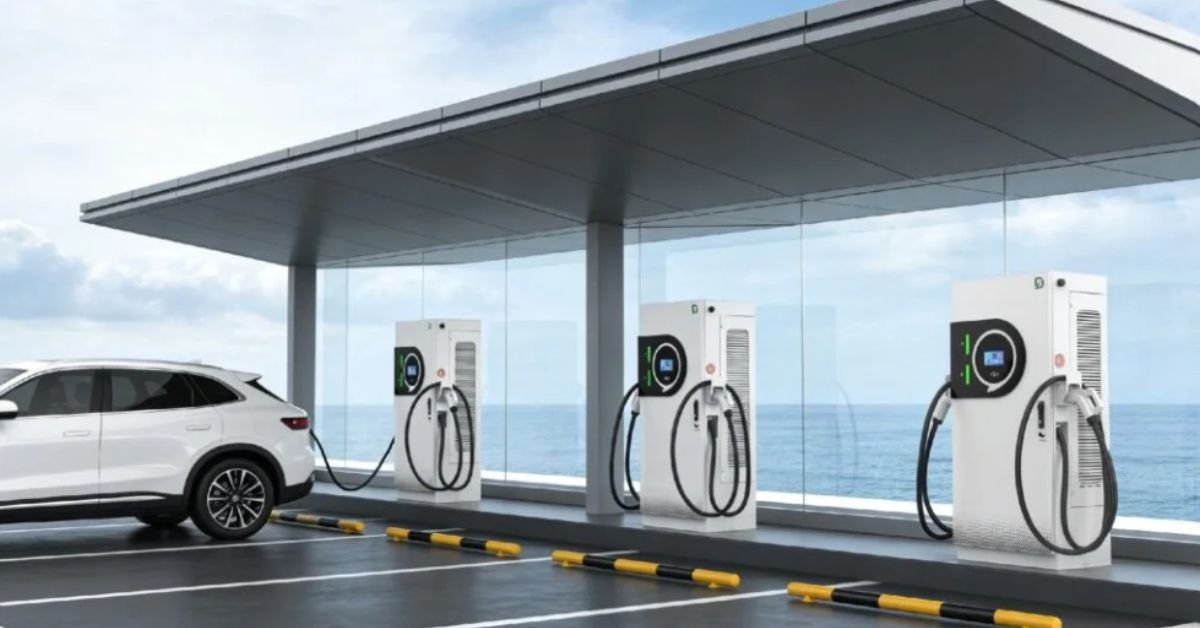
Many commercial EV charging projects begin with a power question: should the site install faster DC chargers, or will AC chargers provide a better return? For retail stores, shopping malls, hotels, and commercial car parks, the answer is rarely determined by maximum output alone. The more useful question is whether charging speed matches the time customers naturally spend at the destination.
If a customer remains on site for only 45 minutes, a 7kW AC EV charger may not deliver enough energy to create a noticeable benefit. By contrast, when a hotel guest parks overnight, installing high-power DC at every space may increase equipment and electrical costs without creating equivalent value. Successful destination charging therefore focuses on delivering sufficient, manageable energy within the natural parking window.
A practical plan brings four variables into the same model: average dwell time, energy required per session, daily space turnover, and the business value expected from charging. Once these variables are understood, an operator can choose a more defensible mix of AC and 20-40kW DC EV chargers.
I. The Business Logic of Destination Charging
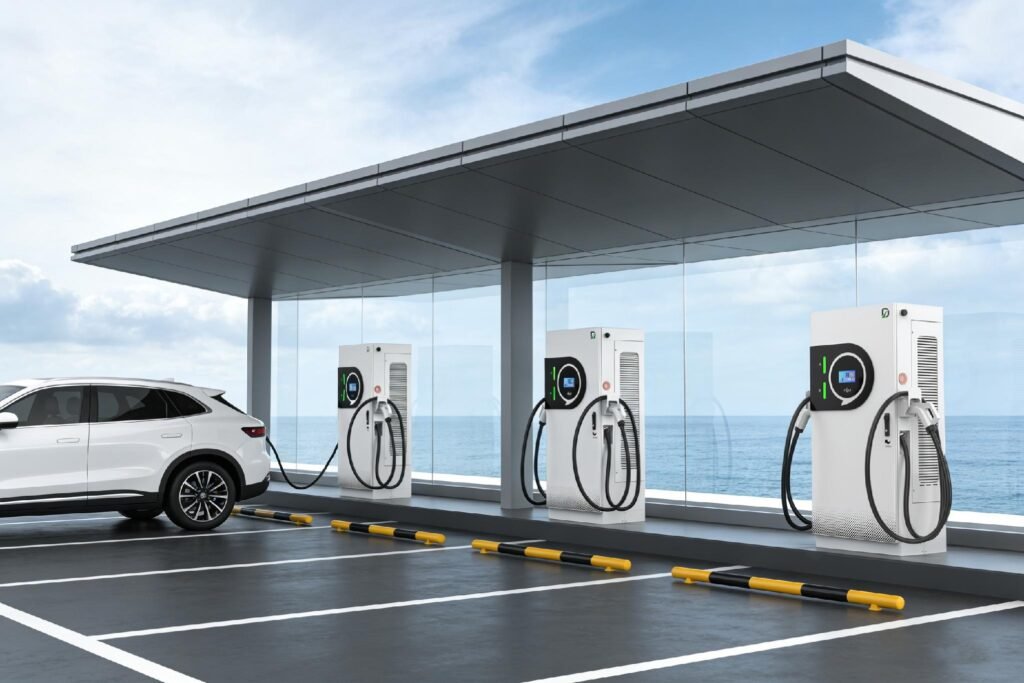
Highway fast charging is designed to reduce waiting. Destination charging has a different purpose. Drivers are already shopping, dining, staying overnight, attending meetings, or leaving their vehicles in a managed car park. Charging runs in parallel with that activity, so dwell time becomes a usable energy window rather than an inconvenience.
This is why one configuration cannot simply be copied across every property. A neighbourhood retailer may see visits of 30-90 minutes. A regional mall may hold customers for 1.5-4 hours. A hotel commonly has an 8-12-hour overnight window. A commercial car park may serve short-stay visitors, full-day employees, monthly subscribers, and overnight residents at the same location.
| Commercial setting | Planning dwell time | Primary charging need | Recommended baseline |
|---|---|---|---|
| Retail and supermarkets | 30-90 min | Noticeable top-up during a purchase | 20-40kW DC, with limited AC |
| Shopping malls | 1.5-4 hr | Mixed short- and medium-stay demand | 11/22kW AC plus 20-40kW DC |
| Hotels and resorts | 8-12 hr | Overnight energy for the next journey | 7/11kW AC plus limited DC |
| Commercial car parks | 2-10 hr | Visitors, employees, and subscribers | AC base layer with DC support |
An EV charging station is therefore more than an electricity-sales point. It can support parking revenue, improve a guest amenity package, create a membership benefit, strengthen a property’s sustainability profile, and make the site more attractive to EV drivers. A model that counts only the margin per kilowatt-hour may underestimate the full value of destination charging.
II. Choosing Between AC and 20-40kW DC
Before selecting power, the project team should estimate how much energy a vehicle can realistically receive during one visit. A useful early-stage formula is:
Energy delivered per session = min(charger output, vehicle acceptance rate) x effective charging time x operating factor
For preliminary modelling, an operating factor of 0.75-0.90 can help account for connection and payment time, charging taper, early departure, and vehicles that remain parked after charging has stopped. The formula also prevents a common mistake: assuming that the charger’s rated output is the power every vehicle will accept throughout the session.
AC EV Chargers: More Ports for Longer Parking Windows
AC charging normally has a lower equipment and electrical threshold, which makes it practical for expanding coverage across more spaces. Hotels, offices, business parks, and long-stay car parks often provide several hours or an entire night for charging. In these settings, 7kW, 11kW, or 22kW AC can deliver useful energy without concentrating excessive capacity at one point.
However, the vehicle’s onboard charger limits AC intake. Installing a 22kW AC unit does not mean every vehicle will receive 22kW. A good feasibility study therefore reviews the AC acceptance rates of common vehicles in the target market, rather than relying only on the output printed on the charger.
20-40kW DC Chargers: Faster Top-Ups for Short and Medium Stays
A 20kW, 30kW, or 40kW DC charger occupies the middle ground between destination AC and high-power rapid charging. Because power conversion takes place in the external charger, DC charging is not restricted by the vehicle’s onboard AC charger. It is therefore well suited to one-to-four-hour parking windows where customers expect a clearly visible top-up.
For retail operators, medium-power DC can add meaningful range during a meal, a shopping trip, or a service appointment. For shopping centres and hotels, it provides a faster premium option without making ultra-high power the default for every space. The result can be a more balanced relationship between customer experience, turnover, grid capacity, and capital cost.
| Decision factor | 7-22kW AC | 20-40kW DC |
|---|---|---|
| Best parking window | 4-10 hours or longer | 1-4 hours |
| Primary strength | Scalable port coverage | More energy within a shorter visit |
| Primary limitation | Vehicle onboard charger may limit intake | Higher equipment and electrical requirements |
| Typical role | Base coverage for guests and employees | Fast top-up and premium service |
| Expansion trigger | Increase ports and use load management | Add units when queuing and paid use justify them |
AC and DC are not competing answers to the same question. In many destination projects, AC provides coverage while 20-40kW DC provides speed.
III. Planning EV Chargers for Four Commercial Settings
Retail Stores: Charging Time Should Not Exceed Shopping Time
Convenience retail, supermarkets, restaurants, and service businesses typically have short visits. If customers leave before the charger has delivered a useful amount of energy, the space may appear occupied without creating a strong charging experience. A 20-40kW DC unit can be prioritised here, positioned where it is visible and easy to enter without blocking the main traffic route.
Charging can also be linked with memberships, purchase discounts, or parking validation. Completely free charging should not automatically be the starting point, because it can encourage long occupancy and make real willingness to pay difficult to measure. A limited-time benefit, member tariff, or purchase-linked credit gives the operator more control.
Shopping Malls: Use a Mixed Configuration for Mixed Dwell Times
Mall customers do not behave as one group. Cinema, dining, and family-leisure visitors may remain for several hours, while a quick-purchase customer may stay less than one hour. An AC-only design weakens the benefit for short-stay drivers; an all-DC design can leave expensive assets underused during quieter periods.
A more resilient approach uses 11kW or 22kW AC for broad coverage and 20kW, 30kW, or 40kW DC for short-stay customers, higher energy needs, and drivers willing to pay for speed. Clear signage and differentiated pricing allow users to select the option that matches their visit.
Hotels: The Goal Is an Overnight Result, Not a 30-Minute Result
For vehicles parked for 8-12 hours, 7kW or 11kW AC often has enough time to provide the energy required for the next day’s journey. Increasing the number of charge-enabled spaces can be more valuable than concentrating the budget in a small number of high-power units, especially when guests do not want to move their cars late at night.
A limited number of 20-40kW DC chargers can still add value near the entrance, restaurant, meeting rooms, or short-stay parking. These units can serve late arrivals, early departures, dining customers, business visitors, and valet operations.
Commercial Car Parks: Segment Users Before Averaging Dwell Time
Commercial car parks can be misled by an overall average. Combining an eight-hour employee stay, a two-hour visitor stay, and an overnight subscriber stay produces a number that may describe none of them. The data should first be segmented by user type, arrival period, and parking product.
Long-stay users can be directed to AC, temporary visitors can choose 20-40kW DC, and total site demand can be controlled with dynamic load balancing. The property then avoids sizing every cable and connection for all chargers operating at full power simultaneously.
IV. Measuring Utilisation Beyond an Occupied Space
Many reports treat parking-space occupancy as charger utilisation. Yet a vehicle that has finished charging and remains parked for three more hours makes the bay look busy while producing no additional energy or revenue. Commercial operators need a small group of operational metrics rather than a single occupancy figure.
| Metric | Method | Management question |
|---|---|---|
| Port occupancy | Occupied time / service time | Are charging spaces busy? |
| Active charging ratio | Charging time / occupied time | Does occupancy convert into charging? |
| Energy utilisation | Actual kWh / theoretical output | Is installed power being used? |
| Sessions per port per day | Completed sessions / active ports | Is turnover appropriate for the site? |
| Average energy per session | Total kWh / successful sessions | How much energy do users actually need? |
| Start success rate | Successful starts / start attempts | Are payment, communication, or usability causing failure? |
| Post-charge occupancy | Departure time – charge end time | Are reminders or idle fees needed? |
| Technical availability | Service-ready time / scheduled time | Is downtime reducing revenue? |
AC and DC should not be judged by identical rules. A hotel AC port may serve only one vehicle per night and still meet its purpose by completing the guest’s required top-up. A retail DC port should normally support more sessions and faster turnover. Comparing both only by vehicles served per day can therefore produce the wrong investment decision.
Queueing data must also be read alongside utilisation. Low use can indicate overdeployment. Sustained high use combined with queues can justify expansion. The target is not to keep every charger at maximum output all day; it is to preserve availability at peak periods while producing enough effective energy throughput to support the business case.
V. Building an Operating Revenue Model
An initial estimate of direct charging contribution can use the following formula:
Monthly charging contribution = ports x sessions per port per day x kWh per session x contribution per kWh x operating days
Contribution per kWh is the selling price minus electricity cost, payment charges, and other costs that change with energy volume. Platform fees, communications, inspection, repairs, land, finance, depreciation, and demand or capacity charges must then be deducted before the result can be treated as operating profit.
Illustrative Calculation
The following figures demonstrate the calculation method only. They are not a return guarantee for any Door Energy customer or charging project.
| Model input | AC area | DC area |
|---|---|---|
| Number of ports | 10 | 2 |
| Power per port | 11kW | 30kW |
| Sessions per port per day | 2.2 | 5 |
| Average energy per session | 18kWh | 24kWh |
| Assumed contribution per kWh | US$0.18 | US$0.25 |
| Monthly energy, 30 days | 11,880kWh | 7,200kWh |
In this example, 12 ports deliver approximately 19,080kWh per month and generate about US$3,938 in charging contribution. The figure is not net profit because fixed operating expenses, depreciation, financing, and site-specific electrical costs have not yet been deducted.
Value Beyond the Electricity Margin
A complete model can also evaluate three additional value pools, provided they are supported by measured site data:
- Parking value: parking fees and service charges associated with charging spaces.
- Commercial value: retail, dining, leisure, meeting, or hotel spending that occurs during charging.
- Customer value: membership growth, repeat visits, property appeal, and support for sustainability objectives.
These benefits should not be invented. Operators can use anonymous links between membership IDs, parking sessions, charging sessions, and sales records to compare dwell time, transaction value, and repeat behaviour between charging and non-charging visitors. Only verified incremental value should be included in a formal investment model.
VI. Door Energy: A Scalable Product Architecture for Destination Charging
Door Energy develops and manufactures EV charging and energy solutions for commercial and industrial customers. The company is built on a technology group established in 2005, with more than 200 engineers and experience supporting over 300 governmental and commercial departments. For destination-charging projects, this background supports a practical combination of product engineering, project customisation, manufacturing, and technical service.
Rather than positioning one power level as the answer for every property, Door Energy offers a tiered fixed-charging portfolio. This allows a retailer, hotel, shopping centre, or car-park operator to align charger power with dwell time and then expand the installation as measured demand develops.
Door Energy W Series AC EV Chargers
The Door Energy W Series provides 7kW, 11kW, and 22kW AC options for commercial applications. Its role is broad, cost-conscious coverage across long-stay spaces such as hotel parking, employee areas, business parks, and managed car parks. Wall- or pole-mounted installation options support phased expansion, while RFID, app, and plug-and-charge start modes can be configured around the intended user journey.
Door Energy C Series 20-40kW DC EV Chargers
The Door Energy C Series includes 20kW, 30kW, and 40kW DC chargers for short- and medium-stay destinations. These outputs are particularly relevant to hotels, resorts, restaurants, golf clubs, shopping locations, and business parks where a one-to-four-hour visit should produce a visible top-up. Wall-mounted and floor-standing formats make the series adaptable to different parking layouts.
For clarity, Door Energy’s 20kW, 30kW, and 40kW fixed DC chargers belong to the C Series. The D Series begins at 60kW and covers 60kW, 80kW, 120kW, and 160kW applications. Keeping these product families separate helps project teams avoid overstating the power required for a destination site.
Open Management and Site-Level Control
Door Energy W Series and C Series chargers can support OCPP-based platform integration, including OCPP 1.6 and optional OCPP 2.0 configurations. Depending on the project specification, operators can combine remote status monitoring, session records, user authentication, fault alerts, pricing control, and network connectivity. Dynamic load balancing can distribute available site capacity across multiple ports instead of allowing every unit to demand full output simultaneously.
This management layer is commercially important. A charger that cannot start reliably, report faults, or integrate with the operator’s chosen workflow can damage utilisation even when its power rating is appropriate. Door Energy therefore treats hardware selection, platform communication, electrical capacity, and user access as connected parts of one deployment plan.
VII. A Five-Step Deployment Plan
Step 1: Collect Parking Data
Separate weekdays from weekends and daytime from overnight periods. Record arrival time, dwell time, turnover, peak concurrency, and user type. Total traffic alone cannot reveal charging demand.
Step 2: Build User and Energy Scenarios
Estimate the share of EV visits, likelihood of charging, energy required per session, and expected growth. Use conservative, base, and growth cases instead of relying on one optimistic forecast.
Step 3: Assess Electrical and Installation Conditions
Review transformer capacity, peak building load, cable routes, civil works, communications, accessibility, fire-safety requirements, signage, and local permits. Charger price is only one element of total project cost.
Step 4: Combine AC Coverage with DC Speed
Use Door Energy W Series AC chargers for long-stay coverage and Door Energy C Series 20-40kW DC chargers where customers need faster energy delivery. The first phase does not need to be the largest phase, but conduits, switchgear, and backend management should leave room for expansion.
Step 5: Let Operating Data Trigger Expansion
Add ports or adjust power when queues, successful starts, technical availability, active charging ratio, and energy per port reach predefined thresholds. If occupancy is high but energy sales remain low, first address pricing, user guidance, or post-charge parking before purchasing more chargers.
VIII. Conclusion
A successful destination-charging project does not necessarily have the highest installed power. It has the correct relationship between parking time, energy need, port availability, and commercial value. AC works best when time is abundant and broad coverage matters; 20-40kW DC works best when customers need a visible top-up within a shorter stay.
For retail, shopping centres, hotels, and commercial car parks, a mixed architecture is often the most adaptable answer. Door Energy supports this approach through the W Series 7/11/22kW AC range, the C Series 20/30/40kW DC range, OCPP connectivity, and load-management options. By starting with measured demand and expanding according to real operating data, property owners can build charging services that improve the customer experience without losing control of electrical capacity or investment discipline.
IX. Frequently Asked Questions
Q1: Should a retail site prioritise AC or 20-40kW DC EV chargers?
A1: If most customers stay for only 30-90 minutes, 20-40kW DC will usually create a more noticeable top-up. If the site also serves employees, offices, or longer dining visits, a limited number of AC ports can be added to create a mixed configuration.
Q2: Does a hotel need DC EV chargers?
A2: Most overnight spaces are better suited to 7kW or 11kW AC because vehicles have the whole night to charge. A hotel can still place a small number of 20-40kW DC units near the entrance, restaurant, meeting area, or short-stay parking for late arrivals and temporary visitors.
Q3: Does higher charger power always produce a higher return?
A3: No. Higher power increases equipment and electrical requirements, while vehicle acceptance rate, dwell time, utilisation, and willingness to pay may not increase at the same pace. Return depends on effective energy sales, pricing, electricity cost, turnover, reliability, and verified commercial value.
Q4: Why is OCPP important for a commercial EV charging station?
A4: OCPP helps connect charging hardware with a management platform for user authentication, session records, remote monitoring, fault alerts, and pricing. It also reduces the risk of making the charging estate dependent on one closed management environment.
Q5: How should a commercial property set charging prices?
A5: Pricing should cover electricity, payment, platform, maintenance, land, and capacity-related costs while matching parking behaviour. Options may include energy-based pricing, time-based pricing, membership tariffs, parking-and-charging packages, and idle fees after charging ends.
Q6: How many charging ports should a project install in phase one?
A6: The starting number should be based on parking data, available electrical capacity, and the expected share of EV visits rather than a fixed percentage of total spaces. The first phase should serve the clearest demand while preserving cable, switchgear, and backend capacity for expansion.
CLICK HERE FOR MORE BLOG POSTS
