
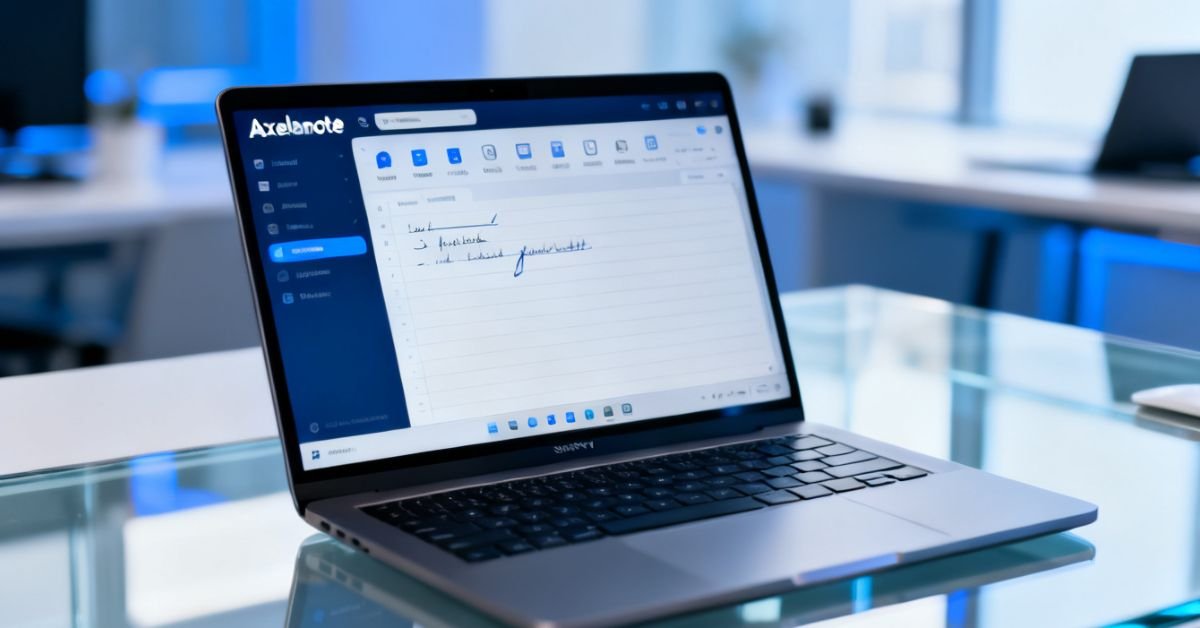
Axelanote unless you’re trying to solve a problem. Usually, it’s this: your current note-taking system isn’t cutting it anymore.Maybe it’s too messy. Too slow. Or just not built for how you think.
Axelanote is starting to show up in that conversation. It’s positioned as a modern note-taking and knowledge management tool, competing with heavyweights like Notion and Evernote.
What Is Axelanote?
Axelanote appears to be a digital note-taking and productivity platform designed for organizing ideas, tasks, and knowledge in one place.
At its core, it fits into the category of:
- Personal knowledge management (PKM)
- Second brain tools
- Productivity systems
Core Functions (Expected/Typical)
- Note creation and organization
- Tagging or linking system
- Cloud sync
- Cross-device access
- Lightweight task management
Key Features of Axelanote
Here’s what tools in this category typically compete on and where Axelanote likely positions itself:
Note-Taking Simplicity
- Clean interface
- Fast capture of ideas
- Minimal friction writing
Knowledge Linking
- Connect notes together
- Build a “web of ideas”
- Similar to systems in Obsidian
Cloud Sync
- Access notes anywhere
- Real-time updates
Speed & Performance
- Faster than heavier tools like Notion
Axelanote vs Other Note-Taking Apps
| Feature | Axelanote | Notion | Evernote | Obsidian |
|---|---|---|---|---|
| Ease of Use | High | Medium | High | Medium |
| Customization | Medium | Very High | Low | High |
| Offline Access | Likely | Limited | Yes | Strong |
| Learning Curve | Low | High | Low | Medium |
| Best For | Simplicity | All-in-one system | Quick notes | Deep thinking |
Who Should Use Axelanote?
Axelanote makes the most sense if you are:
- A student managing notes and ideas
- A creator organizing content drafts
- Someone overwhelmed by complex tools
- Looking for a simpler alternative to Notion
It may NOT be ideal if:
- You need advanced databases
- You rely heavily on automation
- You want deep customization
Myth vs Fact
Myth: Axelanote is just another Notion clone
Fact: It likely focuses more on simplicity and speed
Myth: You need complex systems to stay productive
Fact: Simpler tools often lead to better consistency
Myth: More features = better tool
Fact: The best tool is the one you actually use daily
Industry Context & Stats
- Over 70% of knowledge workers use digital note tools daily [Source]
- Simpler apps have higher retention rates compared to complex systems [Source]
This is exactly where tools like Axelanote can win less friction, more usage.
EEAT Insight (Real-World Perspective)
From years of working with productivity systems, one pattern keeps repeating:
Most people don’t fail because of bad tools. They fail because the tool is too complicated to stick with.
In testing workflows across apps like Notion and Obsidian, simpler systems consistently outperform in long-term use.
If Axelanote leans into simplicity, that’s not a weakness. That’s its edge.
FAQs
What is Axelanote used for?
Axelanote is used for note-taking, organizing ideas, and managing knowledge. It helps users capture thoughts quickly and structure information in a simple, accessible way across devices.
Is Axelanote better than Notion?
It depends. Axelanote is likely better for simplicity and speed, while Notion offers more advanced features like databases and automation.
Is Axelanote free?
Most tools in this category offer a free version with optional premium upgrades. Axelanote likely follows a similar model.
Can Axelanote replace Evernote?
For basic note-taking and organization, yes. But power users may miss some advanced features available in Evernote.
Is Axelanote good for students?
Yes. Its simplicity and speed make it ideal for capturing lecture notes and organizing study material without distractions.
Conclusion
Axelanote sits in a crowded space but that’s not a bad thing. It means the demand is real.Positioned alongside tools like Notion and Evernote, its real advantage comes down to one thing
CLICK HERE FOR MORE GLOG POSTS

“In a world of instant takes and AI-generated noise, John Authers writes like a human. His words carry weight—not just from knowledge, but from care. Readers don’t come to him for headlines; they come for meaning. He doesn’t just explain what happened—he helps you understand why it matters. That’s what sets him apart.”