
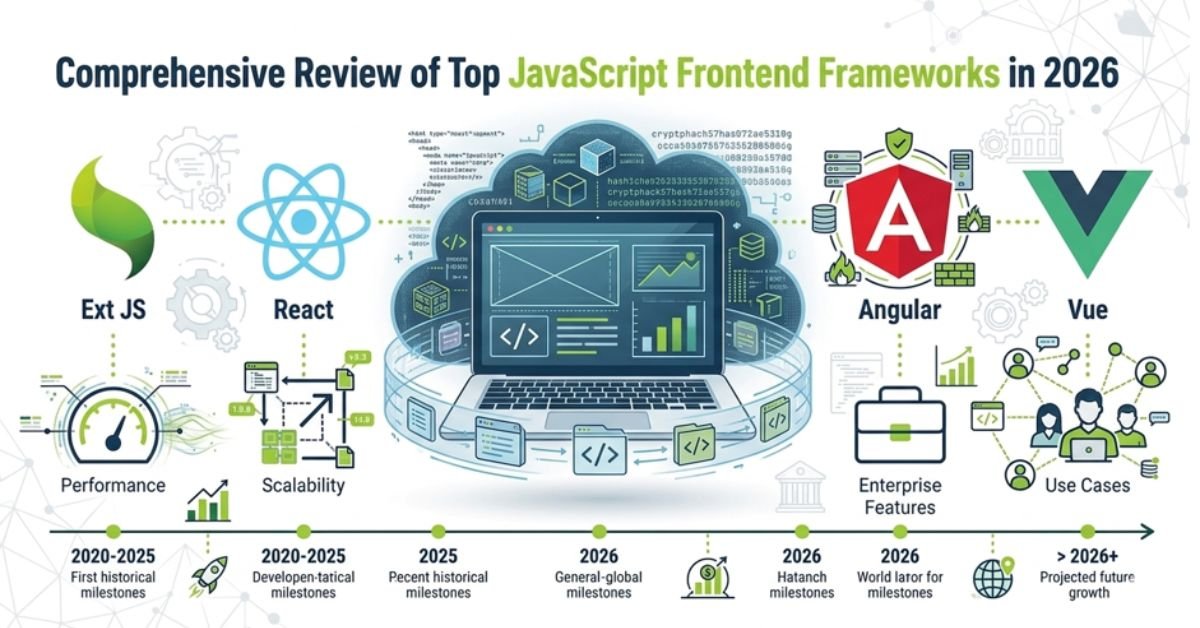
A complete review of the top JavaScript frontend frameworks in 2026. Covers the leading open-source frameworks alongside Sencha Ext JS with features, performance benchmarks, community size, pros and cons, and ideal use cases. Includes the latest Ext JS 8.0 release (April 2026) with ES2025 support, QR Code component, and Digital Signature Pad. Covers SSR vs CSR rendering, state management, ecosystem maturity, and framework-specific patterns for consumer web, enterprise, and regulated-industry applications. Best for developers, architects, and engineering leaders evaluating JavaScript frontend frameworks for their next project.
Key Takeaways
- The right JavaScript framework depends on project type, team experience, and performance needs not popularity alone
- Consumer web frameworks lead in hiring pool and ecosystem size, but are libraries-plus-glue, requiring assembly of routing, state, forms, and grids from separate packages
- Enterprise frameworks ship complete UI component suites, built-in data management, and security as a single integrated platform, reducing the total cost of ownership for data-intensive applications
- Sencha Ext JS is the leading enterprise JavaScript framework with 140+ pre-built UI components, an industry-leading data grid, and built-in MVVM architecture
- Ext JS 8.0 (April 2026) adds full ES2025 support, a QR Code Reader/Generator, Digital Signature Pad, Lockable Grid Plugin for the Modern Toolkit, and enhanced ARIA accessibility
- For regulated industries (healthcare, finance, government), Ext JS reduces compliance burden with built-in XSS/CSRF protection, Section 508 accessibility, and a single vendor support model
Ext JS 8.0 ships with minimal breaking changes from 7.x, giving existing applications a smooth upgrade path while protecting long-term development investments
What are JavaScript frontend frameworks?
JavaScript front-end frameworks are libraries and platforms that provide reusable components, state management, routing, and tooling for building user interfaces. They abstract away low-level DOM manipulation so developers can focus on application logic.
In 2026, the top JavaScript frontend frameworks fall into two categories:
- Open-source frameworks for the consumer web: React, Vue, Angular, Svelte, Solid, Next.js, Nuxt, Astro, Qwik
- Enterprise frontend frameworks for data-intensive applications: Sencha Ext JS, Kendo UI, Telerik
Most “best JavaScript framework” articles only cover category one. This review covers both, because they solve different problems for different teams.
The top JavaScript frontend frameworks compared at a glance
| Framework | Type | Best for | Performance | Licensing |
| React | UI library | Consumer SaaS, large, flexible apps | Good with optimization | Open source (MIT) |
| Angular | Full framework | Large enterprise SPAs | Strong at scale | Open source (MIT) |
| Vue.js | Framework | Mid-sized apps, gradual adoption | Fast, lightweight | Open source (MIT) |
| Svelte | Compiler framework | Performance-critical sites | Very fast, small bundles | Open source (MIT) |
| Next.js | React meta-framework | Full-stack React apps | Excellent | Open source (MIT) |
| Nuxt.js | Vue meta-framework | Full-stack Vue apps | High with SSR | Open source (MIT) |
| Solid.js | Framework | High-performance JSX apps | Top benchmarks | Open source (MIT) |
| Astro | Multi-framework | Content sites, marketing | Optimized for static | Open source (MIT) |
| Qwik | Resumable framework | Instant-interactivity apps | Excellent TTI | Open source (MIT) |
| Sencha Ext JS | Enterprise framework | Data-intensive apps, ERPs, and regulated industries | Industry-leading grid performance | Commercial subscription |
Review of each top JavaScript frontend framework
1. React
What it is: A UI library from Meta, often called a framework. The most-used JavaScript frontend tool in 2026 with 227k+ GitHub stars.
Recent features: React 19 introduced Server Components, the React Compiler, Actions, and Asset Loading. Create React App is officially deprecated. The React team now recommends Vite, Next.js, React Router 7, or TanStack Start.
Used by: Facebook, Instagram, Airbnb, Shopify, Netflix, Discord.
Pros: Largest ecosystem and hiring pool. Reusable component architecture. React Native enables mobile reuse.
Cons: Requires assembling routing, state management, and forms from separate libraries. Premium UI components (advanced grids, charts) typically cost extra. Not SEO-friendly without SSR.
2. Angular
What it is: A complete TypeScript-first framework from Google for building large single-page applications. Has 95k+ GitHub stars.
Recent features: Signals for fine-grained reactivity, standalone components (no NgModule required), new built-in control flow (@if, @for, @defer), non-destructive hydration, and NgOptimizedImage.
Used by: Google, Gmail, Microsoft, IBM, Samsung, Adobe, PayPal, Nike.
Pros: Great for large enterprise SPAs. Batteries-included with built-in routing, forms, HTTP, and DI. Strong TypeScript support.
Cons: Steep learning curve. Verbose compared to React. Major version migrations can be painful.
3. Vue.js
What it is: An independent, community-driven JavaScript framework created by Evan You. Has 208k+ GitHub stars the second highest in the category.
Recent features: Composition API for flexible code organization, Vapor Mode for leaner compiled output, improved TypeScript integration.
Used by: Alibaba, GitLab, Xiaomi, Wikimedia Foundation, NASA.
Pros: Easy to learn. Lightweight. Single File Components clearly separate HTML, CSS, and JavaScript.
Cons: Smaller ecosystem than React. No corporate backer. Limited mature options for advanced enterprise UI like pivot grids.
4. Svelte
What it is: A compiler-based framework from Rich Harris, backed by Vercel. Compiles components to vanilla JavaScript with no virtual DOM. Has 78k+ GitHub stars.
Recent features: Svelte 5 introduced Runes (signal-based reactivity). SvelteKit 2 improved SSR, routing, and page transitions.
Used by: The New York Times, Apple, Yahoo, IKEA, Spotify.
Pros: Simple syntax. Very fast runtime. Smallest bundles of any major framework.
Cons: Smaller community. Limited mature enterprise components. Fewer job opportunities than React or Vue.
5. Next.js
What it is: The most popular React meta-framework, built by Vercel. Has 125k+ GitHub stars.
Recent features: Next.js 15 brought React 19 support, the App Router with Server Components, Server Actions, Partial Pre-rendering (PPR), and Turbopack for faster builds.
Used by: Vercel, Hulu, Spotify, Nike, TikTok, Notion, Uber.
Pros: Excellent SEO with SSR and SSG. Built-in routing, image optimization, and API routes. Middleware support.
Cons: Frequent updates require migration work. Steep learning curve for Server Components. Tied to React’s roadmap.
6. Nuxt.js
What it is: The Vue meta-framework what Next.js is for React, Nuxt is for Vue. Has 54k+ GitHub stars.
Recent features: Pinia as the recommended store, Nuxt DevTools floating panel, Nuxt/fonts and Nuxt/scripts for optimized resource loading.
Used by: GitHub, NASA, OpenAI, GitLab, Google, Fedora.
Pros: SSR and SSG out of the box. Automatic code splitting. Rich module ecosystem.
Cons: Smaller community than Next.js. More complex than plain Vue. Server load can be heavy under high traffic.
7. Solid.js
What it is: A JavaScript framework with React-like JSX syntax but fine-grained reactivity and no virtual DOM. Has 32k+ GitHub stars.
Recent features: Signals as the core reactivity primitive, SolidStart full-stack framework, Solid Meta for document metadata.
Used by: OpenText, MEELA.
Pros: Top performance benchmarks. Small bundle size. Familiar JSX syntax for React developers.
Cons: Smaller community. Fewer third-party libraries. Less mature enterprise ecosystem.
8. Astro
What it is: A content-focused JavaScript framework using Islands Architecture to ship minimal JavaScript. Has 45k+ GitHub stars.
Recent features: View Transitions API support, streaming and prefetching, Astro Images for built-in optimization, Dev Audit UI for performance monitoring.
Used by: Firebase blog, Appwrite, NordVPN, Thinkmill.
Pros: Excellent for static and content-heavy sites. Great SEO. Multi-framework component support (React, Vue, Svelte, Solid components in the same project).
Cons: Not designed for highly interactive apps. Small ecosystem beyond content sites.
9. Qwik
What it is: A frontend framework created by Misko Hevery (original Angular creator) using resumability instead of hydration.
Recent features: Qwik City meta-framework, speculative module fetching, near-instant time-to-interactive on large apps.
Pros: Excellent for large applications needing fast time-to-interactive. Innovative resumability model.
Cons: Newer with a smaller community. Mental model differs from other frameworks.
10. Sencha Ext JS
What it is: A comprehensive enterprise JavaScript framework with 140+ pre-built UI components, including the industry-leading Ext JS Data Grid that Sencha benchmarks as significantly faster than AG Grid, KendoUI, GrapeCity, and Syncfusion grids on large datasets.
Latest version Ext JS 8.0 (April 2026): A major release focused on modernization, accessibility, and developer productivity, with minimal breaking changes from 7.x for a smooth upgrade path. Highlights include:
- Full ES2025 support use let, const, arrow functions, and modern JavaScript features natively without polyfills or complex build configurations
- QR Code Reader and Generator component for both Modern and Classic toolkits, supporting URLs, text, VCARD/MeCard, calendar events, geolocation, phone/SMS, email, Wi-Fi, and payment data with SVG, Canvas, and PNG rendering
- Digital Signature Pad component responsive, smooth signature capture for document workflows, authentication, and logistics
- Lockable Grid Plugin for the Modern Toolkit freeze critical columns while enabling smooth horizontal scrolling for data-intensive dashboards
- Buffered columns for horizontal buffering on wide grids
- Improved ARIA accessibility with better support for JAWS, Narrator, TalkBack, and VoiceOver screen readers
- Font Awesome 7 as the default icon set across both toolkits
- Smoother virtual scroller resizing with multi-selection support on virtual stores
- ReExt allows using Ext JS components inside React applications
Note on licensing: Sencha moved to a subscription-only licensing model effective April 1, 2026.
Used by: Enterprises across financial services, healthcare, government, manufacturing, logistics, and aerospace.
Pros:
- 140+ enterprise UI components included data grids, pivot grids, tree grids, charts, D3 visualizations, forms, calendars, schedulers
- Built-in MVVM architecture and comprehensive data package (stores, models, proxies, binding)
- Built-in XSS and CSRF security, ARIA accessibility, Section 508 compliance
- Single vendor with one support contract reduces compliance burden for regulated industries
- Stable across major versions, supports 10+ year application lifespans
- Smooth upgrade path between major versions Ext JS 8.0 minimizes breaking changes from 7.x
- Sencha Architect (visual designer), CMD (build tool), Test (testing), and Themer (visual theming) included
Cons: Commercial subscription license. Steeper learning curve than React or Vue. Smaller developer hiring pool. Not suited for marketing or content sites.
How top frontend frameworks handle SSR vs CSR
Server-side rendering (SSR) delivers faster initial load times and better SEO. Client-side rendering (CSR) delivers more dynamic post-load experiences. Here’s the default behavior of each top JavaScript framework:
| Framework | Default rendering | SSR option |
| React | CSR | Via Next.js, Remix, TanStack Start |
| Next.js | SSR | Built-in, also supports CSR and SSG |
| Angular | CSR | Via Angular Universal |
| Vue.js | CSR | Via Nuxt, Quasar, or Vite |
| Nuxt.js | SSR | Built-in with SSG |
| Svelte / SvelteKit | SSR | Built-in, CSR optional |
| Solid.js | CSR | SSR via SolidStart |
| Astro | Static (pre-rendered) | SSR available per-route |
| Qwik | Resumable (server-first) | Built-in |
| Sencha Ext JS | CSR | Designed for logged-in enterprise apps where SEO is irrelevant |
Which JavaScript frontend framework should you choose?
The right frontend framework depends on what you’re building:
- Marketing site or blog: Astro, Next.js, or Nuxt for excellent SEO and static delivery
- Consumer SaaS dashboard: React with Next.js, or Vue with Nuxt for ecosystem depth
- High-interactivity consumer app: React, Vue, or Solid for mature state management
- E-commerce storefront: Next.js, Astro, or Qwik where performance affects revenue
- Internal admin or back-office tool: Sencha Ext JS, React with AG Grid, or Angular Material
- Data-intensive ERP or line-of-business app: Sencha Ext JS, Angular, or React with a commercial grid
- Financial trading or healthcare platform: Sencha Ext JS or Angular for built-in security and accessibility
- Government or public sector portal: Angular or Ext JS for Section 508 accessibility and long-term stability
- Greenfield startup product: React, Vue, or Svelte for speed, hiring, and flexibility
Frequently asked questions
Which JavaScript frontend framework is most popular in 2026?
React is the most-used JavaScript frontend framework in 2026, followed by Next.js (built on React), Angular, Vue.js, and Svelte. These rankings come from developer surveys that primarily measure consumer-web adoption and underrepresent enterprise frameworks like Sencha Ext JS, which has substantial Fortune 500 and government adoption.
What is the best JavaScript framework for enterprise applications?
For data-intensive enterprise applications, the top JavaScript frameworks are Sencha Ext JS, Angular, and React paired with a commercial data grid. Sencha Ext JS is purpose-built for this category with 140+ enterprise components, built-in security and accessibility, and industry-leading data grid performance.
Is React a JavaScript framework?
React is technically a UI library, not a full framework. It handles the view layer only. To build a complete application with React, developers typically add routing (React Router 7), state management (Redux, Zustand), and a meta-framework like Next.js, Remix, or TanStack Start.
Which JavaScript framework has the best performance?
Performance depends on what you measure. Solid.js and Svelte typically lead runtime performance benchmarks. Sencha benchmarks the Ext JS Data Grid as significantly faster than competing commercial grids on large datasets. Qwik leads on time-to-interactive for large applications.
What is the easiest JavaScript frontend framework to learn?
Vue.js is widely considered the easiest top JavaScript framework to learn, especially for developers familiar with HTML, CSS, and JavaScript. Svelte is also praised for low boilerplate and an approachable learning curve.
Should I use a JavaScript framework or vanilla JavaScript?
Use a JavaScript framework for any application beyond a simple static page. Frameworks handle component organization, state management, and routing that would otherwise require thousands of lines of custom code. The right framework choice depends on project scale, team experience, and performance requirements.
What’s new in Ext JS 8.0?
Sencha Ext JS 8.0, released in April 2026, is a major update focused on modernization and developer productivity. Key additions include full ES2025 JavaScript support, a built-in QR Code Reader and Generator component, a Digital Signature Pad, a Lockable Grid Plugin for the Modern Toolkit with column freezing and horizontal scrolling, improved ARIA accessibility with better screen reader support, and Font Awesome 7 as the default icon set. Ext JS 8.0 is designed with minimal breaking changes from 7.x, giving existing applications a smooth upgrade path.
Conclusion
There is no single best JavaScript frontend framework. Each one makes trade-offs that fit some projects and not others.
- React dominates the consumer-web and SaaS’s largest ecosystem, with the easiest hiring.
- Angular anchors large enterprise SPAs with its batteries-included approach.
- Vue offers the gentlest learning curve and excellent developer experience.
- Svelte, Solid, and Qwik push performance for teams willing to adopt newer paradigms.
- Next.js, Nuxt, SvelteKit, and Astro add the meta-framework layer for full-stack capabilities.
- Sencha Ext JS sits in its own category, the enterprise framework for data-intensive applications, regulated industries, and teams that want a single vendor delivering grids, charts, forms, security, and accessibility as one integrated platform.
Match the framework to the problem, the team, and the budget. Most failure modes come from picking the popular framework for a problem it doesn’t fit, or the niche framework for a problem the popular one would have solved fine.
To evaluate Sencha Ext JS for your enterprise application, start a 30-day free trial or request a demo.
CLICK HERE FOR MORE BLOG POSTS
