
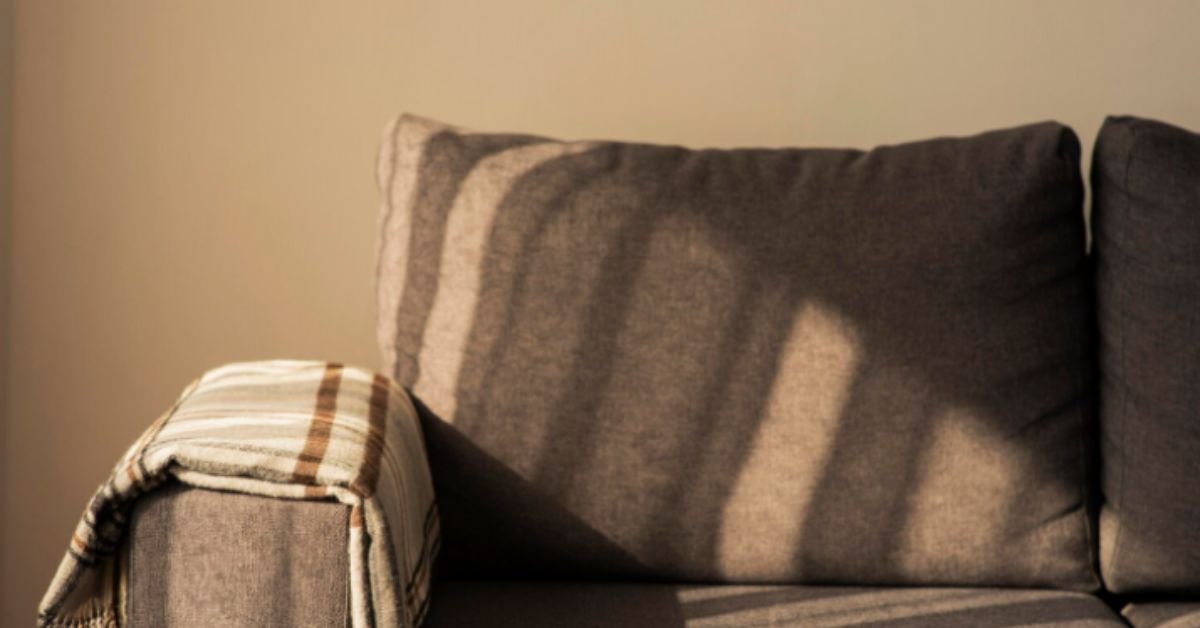
The Damage You Can’t See Happening
Fading is one of the few kinds of household wear that is genuinely invisible while it happens. Nothing looks different on Tuesday than it did on Monday. Nothing looks different this month than it did last month. And then a cushion gets flipped, or a side table gets moved after four years, and there is a rectangle of the original color sitting in the middle of a sofa that everyone had stopped seeing as faded because the change was so gradual.
That reveal is the moment people realize their furniture has been quietly changing color the entire time they’ve owned it. It’s also, more often than not, the moment they discover the second half of the problem — that the fabric hasn’t just lost color, it has lost strength.
Two Separate Injuries
Sunlight does two distinct things to textiles, and only one of them is cosmetic.
Photodegradation of dye is the visible one. Ultraviolet radiation carries enough energy to break the chemical bonds in dye molecules. Broken dye no longer absorbs light the way it did, so the color shifts and lightens. Different dyes fail at different rates, which is why a multicolored fabric doesn’t fade evenly — it shifts in hue as one component degrades faster than the others. Reds and blues commonly go first in ways that leave a fabric looking yellowed or washed out rather than uniformly paler.
Photodegradation of the fiber is the one that matters more. The same UV energy breaks the polymer chains of the fiber itself. The fabric loses tensile strength, becomes brittle, and eventually fails — often at a seam, often suddenly, often while someone is sitting down.
The second injury is well advanced by the time the first is obvious. A curtain that tears when it’s pulled, or upholstery that splits along a sun-facing arm, is fabric that lost its structural integrity long before anyone noticed the color.
Which Fabrics Fail Fastest
Resistance to UV varies enormously by fiber, and the ranking isn’t intuitive.
- Silk is among the least resistant in common use, degrading both in color and in strength relatively quickly under direct exposure
- Nylon is notably vulnerable to UV without stabilizers, which is why nylon outdoor products are usually treated
- Cotton and linen fade readily and weaken over time, with the natural fibers also subject to yellowing
- Wool fades and can yellow, though it holds structural strength somewhat better than silk
- Polyester performs considerably better than most natural fibers, which is one reason it dominates performance upholstery
- Solution-dyed acrylic and solution-dyed olefin are the strongest performers, because the color is incorporated into the fiber during manufacture rather than applied to its surface
That last distinction is the important one for anyone buying. Solution-dyed fiber has pigment throughout, so there is no surface dye layer to degrade first. It’s the reason quality outdoor fabric holds color for years in conditions that would ruin an indoor fabric in a season.
Glass Helps Less Than People Assume
There’s a common belief that ordinary window glass solves this. It partly does and mostly doesn’t.
Standard glass blocks most UVB but transmits a substantial portion of UVA, which is entirely capable of degrading dye and fiber. Visible light and heat also contribute to fading independently of UV, so even a hypothetically perfect UV filter would not stop the process completely.
Low-emissivity coatings and laminated glass perform better, and aftermarket window films can block the large majority of UV. None of them makes a sunny window neutral. They extend the timeline rather than stopping the clock.
The practical consequence is that the sofa positioned in front of the big south-facing window in a bright room is fading right now, glass notwithstanding, and the rate is roughly proportional to how many hours a day the light lands on it.
The Cleaning Connection
Sun damage intersects with cleaning in a way that catches both homeowners and inexperienced technicians off guard.
A faded fabric has compromised dye. Cleaning chemistry that would be entirely safe on a healthy fabric can push a UV-weakened dye over the edge, producing visible color loss during a cleaning that had nothing to do with the cleaning agent’s strength. The fabric was already damaged; the cleaning revealed it.
Weakened fiber behaves the same way with mechanical action. Agitation that a sound fabric shrugs off can abrade or split a sun-degraded one, particularly at the top of an arm or the front edge of a seat cushion.
And there’s an appearance issue worth flagging in advance. Cleaning a faded piece often makes the fading more obvious, because removing accumulated soil restores contrast — and the underlying color difference between exposed and unexposed areas is suddenly easier to see. The cleaning did not cause it. It removed the layer that was partially disguising it.
An honest pre-inspection catches all three, which is why a technician’s questions about window position and sun exposure aren’t small talk. Anyone with a sun-exposed sofa they’re hesitant to have cleaned can find more info on how fabric condition is assessed on Charlotte-area pieces before any work starts.
Slowing It Down
None of this is fully preventable short of a windowless room, but the rate is very much within a homeowner’s control.
- Rotate and flip everything reversible. Cushions turned every few months distribute exposure instead of concentrating it on one face. This is the single highest-return habit and it costs nothing.
- Rearrange furniture seasonally if a piece sits in a fixed sunbeam, or at minimum move it enough that the same panel isn’t taking the same hours of light for years.
- Use window treatments during peak hours. Sheer curtains during the brightest part of the day reduce exposure substantially while keeping the room light.
- Consider UV film on the worst windows. It’s a modest cost against replacing a sofa, and it protects flooring and artwork in the same room.
- Choose solution-dyed fabric for genuinely sunny positions. For a sunroom or a bright bay window, performance fabric is not a compromise — it’s the correct specification.
- Keep protective treatments current. Fabric protectors don’t stop UV, but they reduce soil accumulation, which means less aggressive cleaning is needed on fabric that may already be weakened.
Worth Checking Now
Two minutes of inspection tells you where any given piece stands. Flip a cushion and compare the underside to the top. Pull a side table away from a sofa arm and look at the panel that’s been shaded. Move a throw pillow that’s been in the same corner for years.
Whatever difference you see is what four or five years of exposure produced. If it’s slight, the current arrangement is fine. If the hidden fabric is noticeably richer than the visible fabric, the piece is on a trajectory, and the useful response is to change the exposure now rather than to plan a reupholstery later.
Fabric doesn’t announce this kind of damage. It just quietly becomes a different color, and a little weaker, on a schedule nobody is watching.
CLICK HERE FOR MORE BLOG POSTS
